About Orectolobus maculatus (Bonnaterre, 1788)
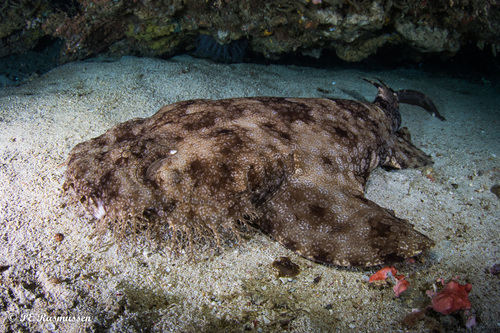
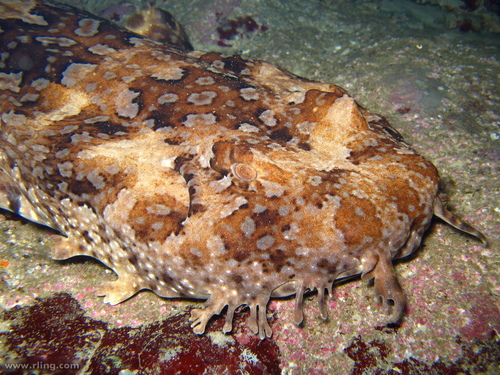
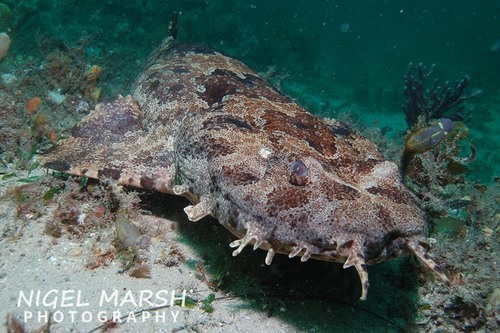
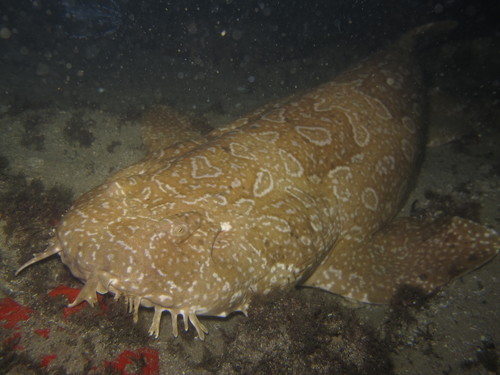
The spotted wobbegong, scientifically known as Orectolobus maculatus (Bonnaterre, 1788), has a large, robust body that tapers beyond the pelvic fins. Adults usually grow between 150 and 180 centimetres (59–71 inches) long, though individuals can reach up to 320 centimetres (130 inches). Its base colour ranges from green, yellow, to brown, with a darker back marked by darker saddle-shaped patches, and its body is covered in distinct O-shaped spots that separate it from similar species. It has six to ten dermal lobes both in front of and behind its eyes, a small tubercle above each eye, and no body ridges or caudal keels. Additional identifying traits include dermal flaps along the rim of its mouth, large barbels extending from its nostrils, and large spiracles. Like all sharks, the spotted wobbegong has numerous pores across its skin that act as electroreceptors, which it uses to detect the electric fields of nearby animals to more easily locate prey. A peer-reviewed study published in Marine & Freshwater Research compared the electroreceptor systems of the spotted wobbegong and the distantly related Australian angelshark (Squatina australis), and found that the spotted wobbegong has a more complex electrosensory system, including a pore cluster inside its snout that is not present in the Australian angelshark. For both species, electroreceptors are an important feeding mechanism. The spotted wobbegong is endemic to Australia, where it typically inhabits tropical waters no deeper than 218 metres (715 ft). A sample of 38 specimens caught between 1882 and 1995 were collected from depths of 20 to 176 metres (66–577 ft). Confirmed sightings have been recorded in Queensland, Victoria, South Australia, and Western Australia, in waters of the western Pacific Ocean and eastern Indian Ocean. There are also records of the species from Tasmania and the Northern Territory, but these are considered likely invalid. Records of this species from Japan and the South China Sea are the result of misidentification of other fish species. In eastern Australia, the primary threat to the spotted wobbegong is commercial fishing, as its flesh is edible, making it a targeted fishing species. In Queensland, it is sometimes caught as bycatch and is not targeted intentionally. Historically, its skin was used for decoration, but it is unknown if this use continues today. Multiple conservation actions for the species have been implemented, particularly since 2006. As of 2015, the population trend is unknown, and the species’ range is not severely fragmented. On 23 March 2015, the International Union for Conservation of Nature listed the spotted wobbegong as a species of Least Concern, after assessing it as Near Threatened in 2003 and 2009. The spotted wobbegong is a nocturnal species: it feeds at night, and rests on sandy bottoms, in coral reefs, and in coastal bays during the day. Adults most commonly live on algae-covered rocky reefs, and in seagrass meadows or sandy plains, while juveniles are mostly found in estuaries. Its colour pattern allows it to camouflage effectively against rocky bottoms. While this has not been confirmed, the species may return repeatedly to the same site throughout its life. Its diet includes a range of fishes, such as luderick, scorpionfishes, sea basses, smaller sharks (including other spotted wobbegongs), and rays, plus various invertebrates including crabs, lobsters, and octopuses. Like all wobbegongs, it has a short mouth and broad pharynx that let it suck prey in more easily. Prey have been observed wandering close to the spotted wobbegong, right up to its mouth, and sometimes even nibbling its tentacles. Spotted wobbegongs form social groups. Previously, researchers thought group formation was random, or driven by access to food, but a 15-month study led by Macquarie University conducted in a small marine reserve concluded that spotted wobbegongs associate with preferred partners for social purposes, and some individuals do not associate with groups at all. Out of 15 tagged and observed individuals, 14 associated with more than one other shark, and association patterns were not affected by sex, size, or familiarity between individuals. Lead researcher Rob Harcourt noted that the sharks interact in much more complex ways than researchers had previously predicted. Female spotted wobbegongs give birth in spring, after a gestation period of almost a year. The species is ovoviviparous, meaning embryos develop inside the mother’s body until they are ready to hatch. Litters typically contain between 20 and 37 pups. Newly hatched young measure 21 centimetres (8.3 in) long, and males reach sexual maturity at roughly 60 centimetres (24 in) long. Males in the Sydney area, likely including this species, fight with other males during the breeding season. Males have also been observed biting females during courtship.