About Oreamnos americanus (Blainville, 1816)
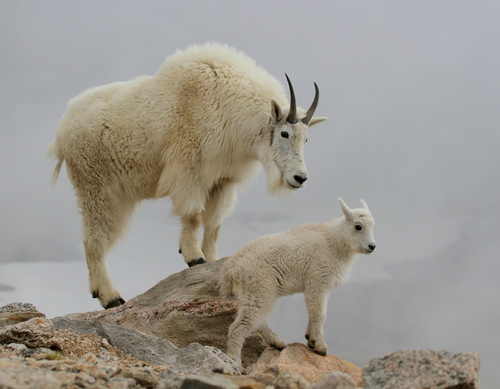
Both male and female Oreamnos americanus, commonly known as mountain goats, have beards, short tails, and long black horns 15 to 28 cm (5.9 to 11 in) in length that feature yearly growth rings. A woolly greyish white double coat protects them from cold and harsh weather. Their undercoats are made of fine, dense wool, covered by an outer layer of longer, hollow hairs. Mountain goats molt in spring by rubbing against rocks and trees: adult male goats (called billies) shed their extra wool first, while pregnant female goats (called nannies) shed last. Their thick coats let them withstand winter temperatures as low as −46 °C (−51 °F) and winds reaching up to 160 kilometres per hour (99 mph). An adult male mountain goat stands about 1 m (3.3 ft) at the shoulder and can weigh around 30% more than a female in some cases. Males also grow longer horns and longer beards than females. Total head-and-body length ranges from 120 to 179 cm (47 to 70 in), and a small tail adds an extra 10 to 20 cm (3.9 to 7.9 in). The mountain goat's feet are specially adapted for climbing steep, rocky slopes with pitches over 60°: inner pads provide traction, and their cloven hooves can spread apart. Sharp dewclaws on the tips of their feet prevent slipping. They also have strong shoulder and neck muscles that help push them up steep inclines. Researchers recorded a mountain goat climbing a 45-degree slope in the Canadian Rocky Mountains to measure its full-body movement during climbing. In the first phase of propulsion, the goat extended its back legs and tucked its front legs close to its chest. In the second phase, the goat pulled its back legs up near its chest, while the humerus of the front leg stayed locked in a fixed position relative to the goat's chest. This keeps the elbow held close to the body's overall center of balance. Extending the elbow and carpal joints moves the goat's center of mass vertically upward along the slope. Mountain goats live in the Rocky Mountains, Cascade Range, and other mountain regions of the North American Western Cordillera, ranging from Washington, Idaho and Montana through British Columbia and Alberta, reaching as far north as southern Yukon and southeastern Alaska. Half of the world's entire mountain goat population lives in British Columbia. The northern edge of the species' range is along the northern fringe of the Chugach Mountains in south-central Alaska. Introduced populations have established in Idaho, Wyoming, Utah, Nevada, Oregon, Colorado, South Dakota, and Washington's Olympic Peninsula. Mountain goats are the largest mammals that live in their high-altitude habitats, which can reach elevations over 4,000 m (13,000 ft). They are primarily an alpine and subalpine species, but will sometimes descend to sea level in coastal areas. They usually stay above the tree line year-round, but make seasonal migrations to move between higher and lower elevations within their range. Winter migrations to low-elevation mineral licks often require them to travel several kilometers through forested areas. In the wild, mountain goats typically live 12 to 15 years; their lifespans are limited by their teeth wearing down over time. In captivity in zoos, they can live 16 to 20 years. Mountain goats reach sexual maturity at around 30 months of age. Female nannies in a herd enter synchronized estrus from late October through early December, when males and females take part in a mating ritual. Mature billies stare at nannies for long periods, dig rutting pits, and fight each other in dramatic, occasionally dangerous, scuffles. Young billies often try to participate in mating, but nannies usually ignore them and prefer to mate with older males. Both males and females generally mate with multiple partners during breeding season, though some billies will attempt to exclude other males from access to specific nannies. After breeding season ends, males and females separate. Nannies form loose nursery groups that can include up to 50 animals, while adult billies leave, most often staying alone or grouping with two or three other males. Kids are born in spring, in late May or early June, after a six-month gestation period. Nannies move to an isolated ledge to give birth, and almost always produce a single offspring. After birth, nannies lick the kid dry and consume the placenta. Newborn kids weigh just over 3 kg (6.6 lb), and begin running and attempting to climb within hours of birth. Lactation is mostly complete by one year of age, but kids stay close to their mothers for the first full year of life, or until the nanny gives birth again if she does not produce a new kid in the next breeding season. Nannies protect their young by leading them away from danger, standing over them when confronted by predators, and positioning themselves below kids on steep slopes to stop them from falling.