About Orchesella cincta (C.Linnaeus, 1758)
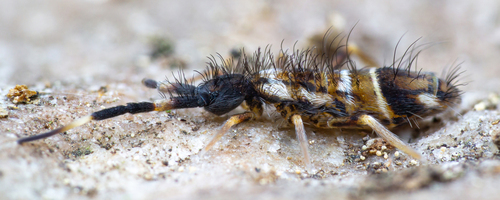
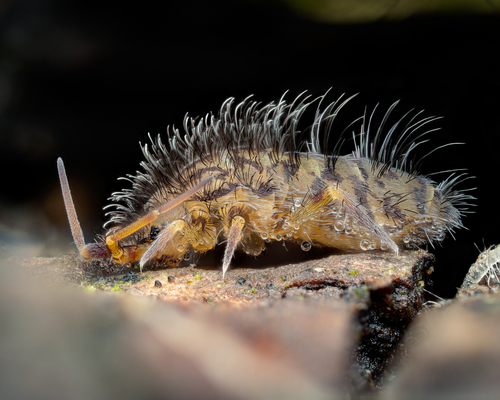
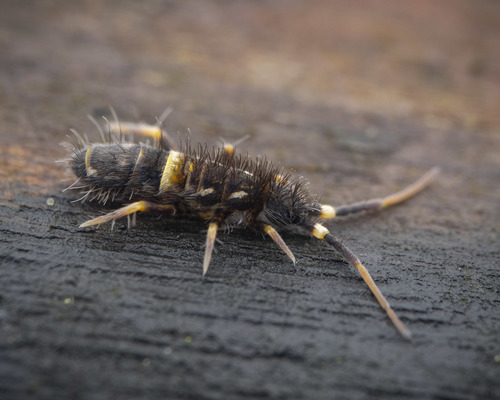
Orchesella cincta (C. Linnaeus, 1758) is a species of springtail, a group of small, wingless relatives of insects. Springtails typically have six abdominal segments, a tubular appendage that projects downward from the first abdominal segment, and a forked tail-like appendage called a furcula. This furcula is folded under the last abdominal segment, and allows the animal to flip itself into the air. All members of the genus Orchesella have six antennal segments. Orchesella cincta reaches approximately 4 mm (0.16 in) in length. It has distinctly dark pigmentation on its third abdominal segment and third antennal segment. By contrast, the posterior part of the second abdominal segment and the distal part of the second antennal segments are white. The fifth and sixth antennal segments are brown; overall colouring of the antennae and abdomen is otherwise variable, ranging from reddish-brown through various shades of brown to blackish. The body is densely covered in hairs. Antennae are often unequal in length, which may be caused by antennal damage during development. Orchesella cincta is distributed in Western Europe and Canada. Within Western Europe, it has been recorded in Norway, Sweden, Switzerland, France, the Netherlands, and the British Isles. It is one of the most common springtail species in the British Isles, with known populations across multiple locations in Scotland, England, Wales, and Ireland. It is also common on Saint Helena, a mid-Atlantic island, where it was likely accidentally introduced with plant material. This species lives in soil and among leaf litter in woodland habitats. It can be kept in laboratory conditions on twigs coated with green algae. Ecologically, Orchesella cincta acts as both an herbivore, feeding on living and dead plant tissue, mosses, algae, and lichens, and as a fungivore/bacterivore. Like other springtails, O. cincta continues moulting throughout its entire lifespan. In this species, feeding and reproductive life stages (instars) alternate. When environmental conditions are unfavorable, such as during dry periods or at low temperatures, reproductive phases can be delayed until conditions improve. Once conditions improve, reproductive activity begins synchronously across the entire population. This is a successful survival strategy, as the resulting population surge lets the species take full advantage of available resources. Orchesella cincta has a high metabolic rate and a high fertility rate, it is more mobile than many springtail species, and is more likely to spread into new habitats, including plant foliage and tree crevices.