About Orcaella brevirostris (Owen, 1866)
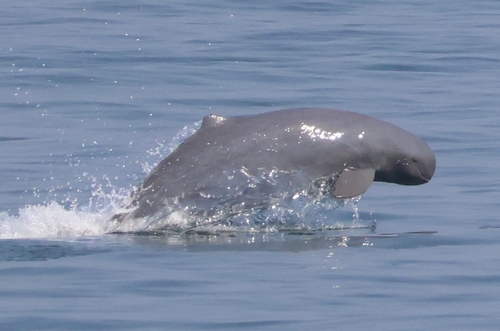
Orcaella brevirostris, commonly known as the Irrawaddy dolphin, is generally colored grey to dark slate blue, with a paler underside and no distinctive patterning. Its small, rounded dorsal fin is located behind the midpoint of its back; individual Irrawaddy dolphins can vary in their dorsal fin shape. The dolphin has a high, rounded forehead, no distinct beak, and a blunt snout tip. Its flippers are broad and rounded. Finless porpoises (Neophocaena phocaenoides) have a similar overall appearance but lack a dorsal fin, while humpback dolphins (Sousa chinensis) are larger, have longer beaks, and larger dorsal fins. Irrawaddy dolphins also resemble belugas in outward appearance, but are most closely related to killer whales. More detailed physical traits include a large melon, a blunt rounded head, a dorsal fin that sits two-thirds of the way back along the back, and an unusual U-shaped blowhole that sits left of the midline and opens toward the front of the animal, a trait not seen in any other dolphin. Each side of the dolphin's jaws holds 12 to 19 peg-like teeth. Fully mature Irrawaddy dolphins range from 90 to 200 kg (200 to 440 lb) in weight and reach around 2.3 m (7.5 ft) in length. The maximum recorded length for the species is 2.75 m (9.0 ft), from a male individual found in Thailand.
The Irrawaddy dolphin is an oceanic dolphin that inhabits brackish water near coasts, river mouths, and estuaries, with established freshwater subpopulations in several major rivers: the Ganges, Mekong, and Ayeyarwady (the river after which the species is named). Its overall range extends from the Bay of Bengal to New Guinea and the Philippines, and it does not typically venture offshore. It is frequently sighted in estuaries and bays across Borneo, from Sandakan in Sabah across most of Brunei and Sarawak, and a specimen has been collected from the Mahakam River in East Kalimantan. Reported sightings in Chinese, Taiwanese, and Hong Kong waters are considered unreliable, so the species' presence in these areas is unconfirmed.
Recorded population counts for specific regions are as follows: Bangladesh has approximately 3,500 individuals in coastal waters of the Bay of Bengal, and 451 in the brackish Sundarbans mangrove forest. As of 2021, India hosts 156 individuals in the brackish Chilika Lake, Odisha. As of 2024, Cambodia has approximately 105 individuals in a 190-km (118-mi) freshwater stretch of the Mekong River. Indonesia has approximately 70 individuals in a 420-km (260-mi) freshwater stretch of the Mahakam River. In the Philippines, there are approximately 35 individuals in the brackish inner Malampaya Sound, Palawan; at least 20 in Quezon, southern Palawan; 30–40 in waters around Pulupandan, Bago, Negros Occidental, Guimaras, and Iloilo in the Western Visayas and Negros Island Regions; and at least two in San Miguel Bay, Bicol, which is the easternmost population and the only population found in the Pacific Ocean. Myanmar has between 58 and 72 individuals in a 370-km (230-mi) freshwater stretch of the Ayeyarwady River. Thailand hosts fewer than 50 individuals, possibly as few as 14, in brackish Songkhla Lake. The species has been extinct in Laos since 2022.
It is thought that Irrawaddy dolphins reach sexual maturity between 7 and 9 years of age. In the Northern Hemisphere, mating occurs from December to June. Gestation lasts 14 months, and females give birth to a single calf every 2 to 3 years. Newborn calves measure around 1 m (3.3 ft) in length and weigh approximately 10 kg (22 lb). Calves are weaned after two years, and the species' typical lifespan is around 30 years.