About Opuntia polyacantha var. trichophora (Engelm. & J.M.Bigelow) J.M.Coult.
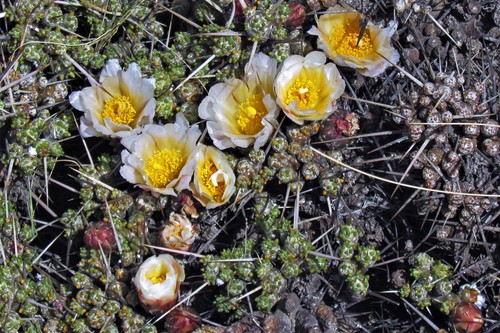
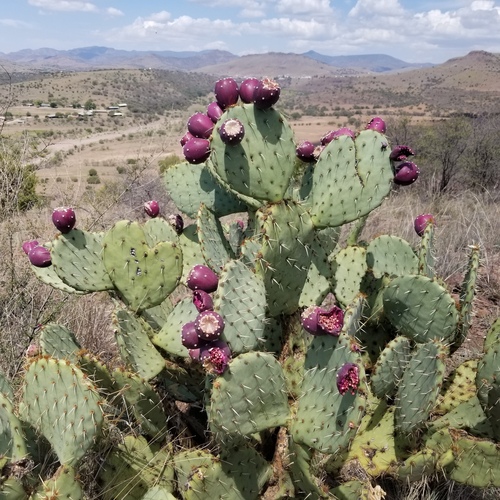
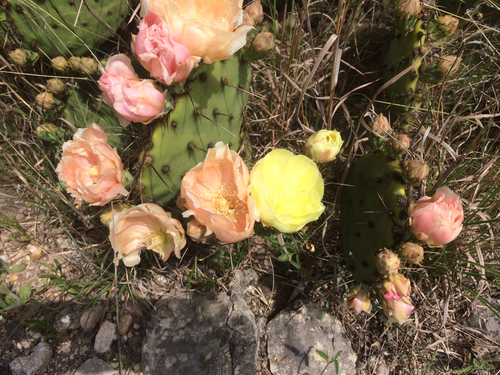
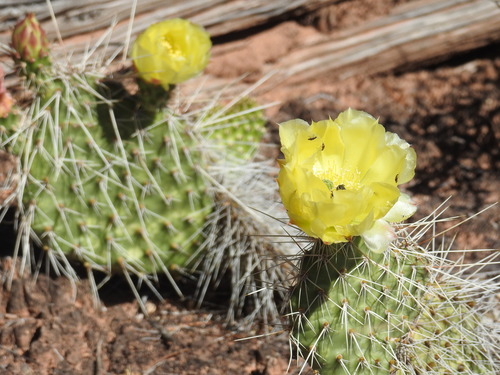
This is the description of the variety Opuntia polyacantha var. trichophora, a pricklypear cactus. Opuntia polyacantha grows 10 to 30 centimeters (4 to 12 inches) tall, forming low mats of pads that can be 2 to 3 meters (6 1/2 to 9 7/8 feet) wide. Its succulent green pads are oval or circular, reaching up to 27 by 18 centimeters (10 5/8 by 7 1/8 inches) in size. Areoles on the pads are tipped with woolly brown fibers and glochids; many areoles bear spines that vary widely in size, shape, and color. Spines range from 0.4 to 18.5 centimeters (1/8 to 7 1/4 inches) in length, and can be stout or thin, straight or curling. Flowers grow from semi-flattened pear-shaped, spine-covered stem segments. They are 2.5 to 4 centimeters (1 to 1 5/8 inches) long, and may be yellow, magenta, or red, turning pink or orange as they age. The fruit is cylindrical, brownish, dry, and spiny. This cactus reproduces by seed, layering, and re-sprouting from detached stem segments. Across its natural range, it tolerates an extremely wide range of temperatures, surviving as low as −46 °C (−50 °F) in Canada's Yukon Territory and well above 38 °C (100 °F) in Chihuahua, Mexico. This taxon is native to North America, with a widespread distribution across western Canada, the Great Plains, central and western United States, and Chihuahua in northern Mexico. In 2018, a disconnected population was discovered in the Thousand Islands region of Ontario, Canada. This cactus grows in a wide variety of habitat types, including sagebrush, Ponderosa pine forest, prairie, savanna, shrublands, shrubsteppe, chaparral, pinyon-juniper woodland, and scrub. Individual plants grow best in sandy soil, and new plants can develop from a displaced stem segment. Native Americans used this cactus as a medicinal plant, with different plant parts used to treat different symptoms. This pricklypear provides food for many types of animals; in one area, it makes up over half of the winter diet of the black-tailed prairie dog. Pronghorn antelope feed on it, especially after spines are burned off during wildfires. When little other food is available, ranchers intentionally burn stands of this cactus to make it edible for livestock. It can even grow in waste areas where higher-quality forage cannot grow, so an abundance of this cactus indicates poor-quality land. Several insect species attack this cactus: the cactus moth Melitara dentata, the blue cactus borer Olycella subumbrella, and the cactus bug Chelinidea vittiger. The Lewis and Clark Expedition encountered this species, noting both admiration and frequent complaints about it. When the skin and seeds are removed, the fruit can be eaten raw or made into candy.