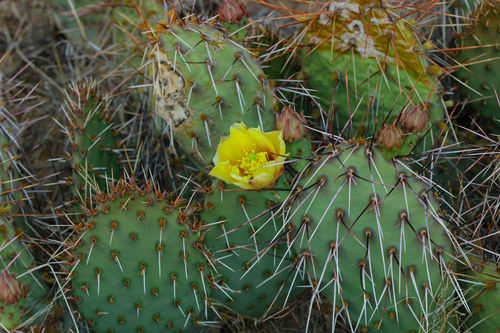
About Opuntia phaeacantha var. major Engelm.
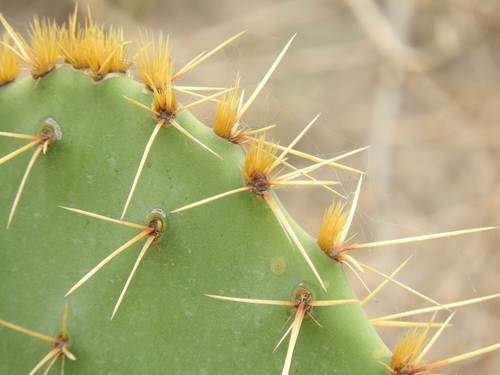
Opuntia phaeacantha grows in a mounded form with flattened green pads, which are protected by clusters of spines. Each cluster holds 1 to 4 spines that range in color from brown and reddish-brown to yellowish or gray; the spines are typically darker brownish toward their base than at the tip, and often grow longer than 3 cm. At the base of each spine cluster sits a round tuft of easily detached yellowish to reddish or brown bristles called glochids, which are also found on the plant’s fruit. This feature gives the plant its common name "prickly pear". The flowers of Opuntia phaeacantha are bright yellow with a pale green to orange or red center; occasional plants growing in some regions may produce flowers in other colors, such as orange, pink, or magenta. Its edible fruits are usually red or purple, with pink seedy flesh and a mild flavor similar to watermelon or pear. Both the fruit and fleshy pads of this cactus are an important food resource for desert wildlife. Like other Opuntia species, this plant is commonly attacked by the cactus moth. Other common names for this species, including names for variants now classified as part of this species, are plateau prickly-pear, New Mexico prickly-pear, and Kingman prickly-pear. The species is widespread across the southwestern United States, ranging from California south into Mexico. It has many existing variations, which may be formally described as distinct varieties or full species in the future. This cactus can be prepared as food in the same way as Opuntia humifusa.