About Opuntia hyptiacantha F.A.C.Weber
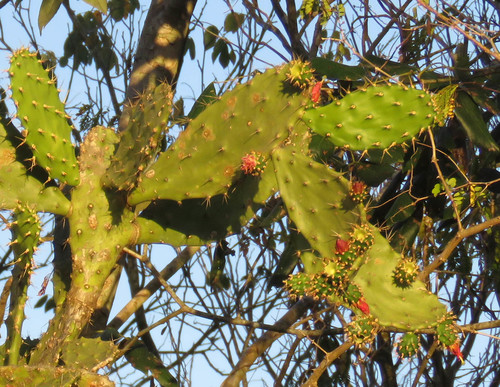
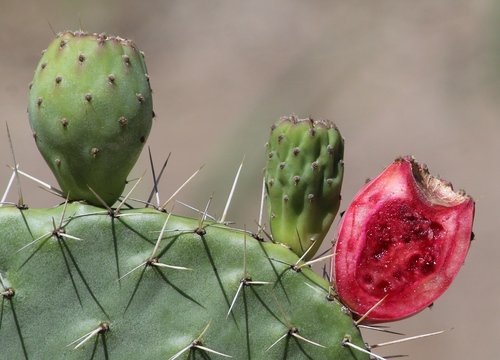
Opuntia hyptiacantha F.A.C.Weber is a tree-like cactus species, growing 1.5 to 5 meters tall with open branching, and can sometimes form a canopy nearly 2 meters in diameter. It has a distinct defined trunk that measures up to 200 cm tall by 20 cm thick, with a grayish to blackish, spiny surface, and scaly bark arranged in wavy longitudinal bands. Its cladodes are widely obovate, measuring 22 to 35 cm long, 15 to 25 cm wide, and 1 to 3 cm thick. The cladode color ranges from bright greenish yellow to dark green-blue, and they are covered with a white, pruinous waxy coating. The epidermis is glabrous and opaque. Areoles are arranged in 10 to 16 series, spaced 2 to 3 cm apart from each other. They are circular pyriform at the base of the cladode and obovate to pyriform across the upper portion of the cladode, measuring 4–6 mm by 2 mm, with brown felt in the center and blackish tissue around the edge of the areole. Glochids are 0.1 to 1 cm long, and greenish yellow. Thorns are 3 to 8 cm long overall, increasing in length as the plant ages; they are subulated, slightly angled, divergent, not appressed, flattened but not twisted, measuring 0.2 to 2 cm across, white with a translucent yellow apex. Open flowers measure 9.5 cm long and 9 cm in diameter, and are yellow; they have yellow filaments and anthers, a pink style, and 6 stigma lobes. Outer floral segments are spatulate with a mucronate apex, light yellow, with a broad reddish central band. Inner floral segments are spatulate with a mucronate apex, and yellow. The pericarpel is 4 to 4.5 cm long. Fruits are obovate to subglobose, and range in color from light red to deep intense red. They have a thick pericarpel 1 to 3 cm wide, with acidic flesh. Fruit areoles are subcircular to obovate, with yellow felt, a yellow gland, and deciduous yellow spines 1.2 cm long. The fruit pulp is red. The floral scar is 2.2 cm in diameter, almost flat, and 0.7 cm deep. Seeds are reniform, angled, with a narrow white aril and a lateral hilum. This species occurs in tropical wet and dry climates (which have at least one month with less than 600 mm of rainfall), and also grows in some semi-arid (continental arid climate with annual rainfall under 600 mm) and dry winter subtropical sites. In this range, the wettest summer month receives 10 times more rainfall than the driest winter month. It can also grow in temperate and cold zones with higher humidity, conditions that occur in parts of central Mexico. The average annual temperature in its habitat ranges from 20 to 29 °C, and average annual rainfall varies between 300 and 1800 mm. Opuntia hyptiacantha grows primarily on volcanic and stony soils, at elevations from sea level up to 1900 meters.