About Opuntia engelmannii var. cujia Griffiths & Hare
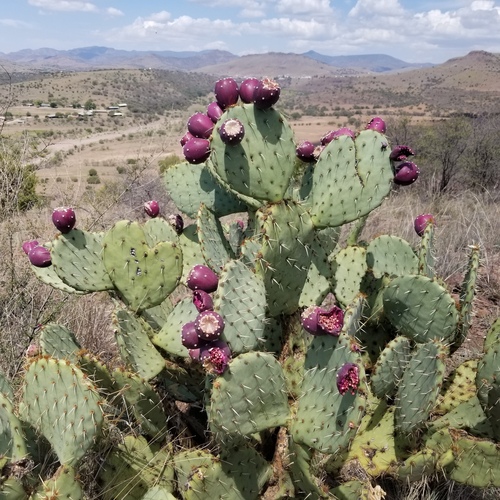
This is the description of Opuntia engelmannii var. cujia, a variety of Opuntia engelmannii. O. engelmannii is generally a shrubby cactus that forms dense clumps up to 3.5 metres (11 ft) high, and usually does not have an obvious trunk. Its flattened stem segments, called pads or cladodes, are green (rarely blue-green), shaped obovate to round, and measure about 15–30 cm long and 12–20 cm wide. In the Sonoran Desert, the terminal pads of this cactus mostly face east-west, an orientation that maximizes absorption of solar radiation during summer rains. The cladodes form the stem of the cactus and act as its primary photosynthetic structure. O. engelmannii typically grows in high-altitude deserts, where lower atmospheric pressure increases water stress and can make gas exchange difficult. For this reason, it relies on CAM photosynthesis, which enables more efficient gas exchange and reduces water loss. Its glochids (small, barbed spines) are yellow when new, and turn brown as they age. The larger cactus spines are nonvascular modified leaves that grow in clumps from areoles (small specialized cushion-like structures on cacti). Spines are extremely variable: there can be 1 to 8 spines per areole, and spines are often absent from lower areoles. They range in color from yellow to white, are slightly flattened, and grow 1–6 cm long. Spines harden from the tip downward and develop a waxy cuticle; they do not perform photosynthesis. Their primary function is defense, but they also facilitate asexual reproduction: when spines latch onto animal fur, the animal may carry away an entire cladode while trying to remove it, and the cladode can later detach and grow into a new plant. Plants in the Opuntia genus grow both taproots and adventitious roots; some taproots function as water storage. Deeper roots anchor the plant and absorb water from deeper underground reserves, while shallow roots spread across a large area to absorb rainfall quickly. A key trait of Opuntia species is that both root types can develop from areoles on cladodes. This is particularly useful for propagation, as separated cladodes can grow new roots and shoots from their areoles to form an independent new plant. Opuntia species are typically colonized by arbuscular mycorrhizal fungi. Mycorrhizal colonization of Opuntia is higher in summer than in winter, and higher when water is abundant. The fungi help the cactus cope with drought stress. The flowers of O. engelmannii are yellow, occasionally reddish, and measure 6-9 cm in both diameter and length. The flowers are hermaphroditic with inferior ovaries, and their stamens are thigmotropically sensitive. Flowering occurs in April and May, and individual blooms last 1 to 2 days. Single-day blooms open around 11 AM and stay open for 6 hours. Two-day blooms open around 10 AM and remain open until 4:30 PM on the first day; on the second day, they open from 8:30 AM to 2:00 PM, resulting in an average total open time of 12 hours per bloom. Flowers produce nectar to attract pollinators, and O. engelmannii produces more nectar than other Opuntia species. Plants in the Opuntia genus primarily undergo cross-pollination, but are also generally self-compatible. Cross-breeding between different Opuntia species has also been observed. Known pollinators include solitary bees and sap beetles. Most pollinators of O. engelmannii are polylectic, meaning they pollinate many unrelated plant species, but several specialized pollinators have evolved to target Opuntia, including members of the Anthophorini, Andrenidae, and Megachilidae groups, which are mostly solitary bees. Large and medium-sized bees are considered the most effective for inter-plant pollination. Beetles and smaller bees are typically classified as "pollen thieves", as they often collect pollen without successfully pollinating the flower. The fleshy fruits of O. engelmannii are purple, 3.5 to 9 cm long, and 2-4 cm wide. They are spineless and glabrous (hairless), and are most often ovate-elongate or barrel-shaped. The fruits are sweet and eaten by many animals, including humans. Opuntia seeds are ovoid or lens-shaped, averaging 0.45 cm long, 0.35 cm wide, and 0.16 cm thick. The seed funiculus is thick and white, and the embryos are typically curved. O. engelmannii fruits usually contain an average of 144 to 172 seeds. The seeds can remain viable in soil for at least 19 months before germinating. Within its native North American range, O. engelmannii seeds are often dispersed by coyotes. O. engelmannii is native to subtropical regions of North America. It prefers hot, dry conditions, but is more frost-tolerant than other Opuntia species. Its native range extends from California to Louisiana in the United States, and from the Mexican states of Sonora and Chihuahua to the Tamaulipan matorral in northern and central Tamaulipas. While it is occasionally found in the Mojave Desert, it is mostly replaced there by Opuntia basilaris, which does not require summer rain. It has become naturalized and invasive in southern and eastern Africa, including Loisaba in Kenya. It was also recorded in Spain in the early 2000s, where it remains invasive. Historically, the fruits were a dependable summer food source for Native American tribes. The Tohono O'odham people of the Sonoran Desert specifically classify the fruits of this cactus by color, ripening time, and storage life. O. engelmannii is cultivated as an ornamental plant, used in drought-tolerant gardens, container plantings, and natural landscaping projects. It has also been used as a living hedge and as cattle fodder. These useful traits, combined with its ability to survive drought, led to its import to various locations across Africa.