About Opsopoeodus emiliae Hay, 1881
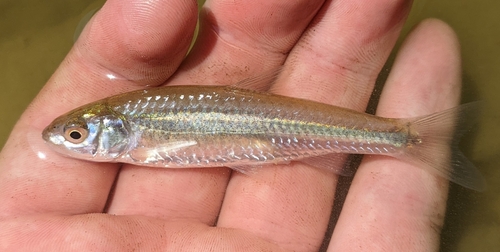
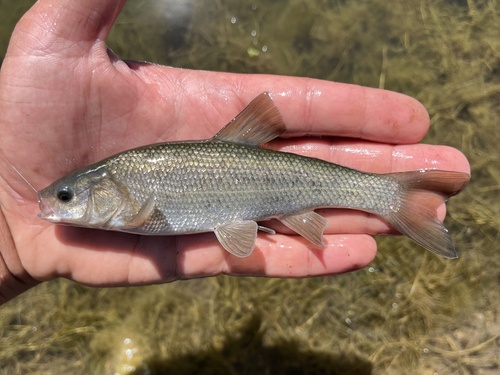
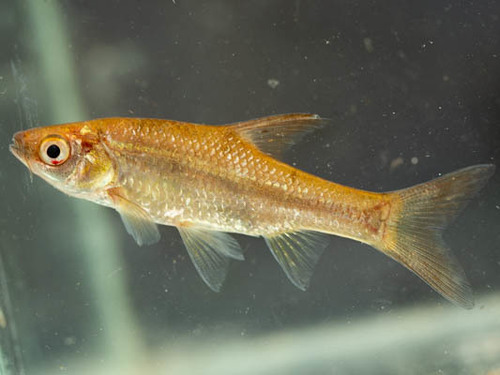
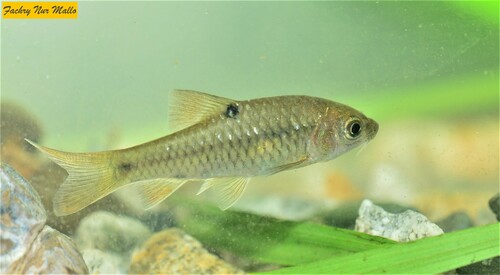
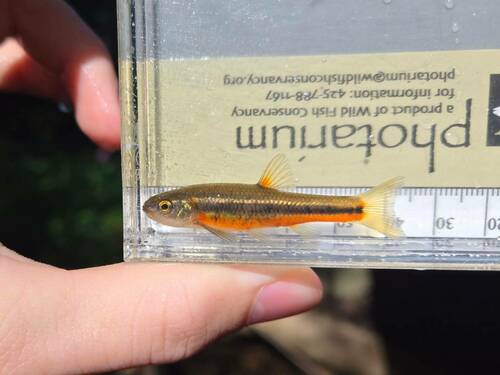
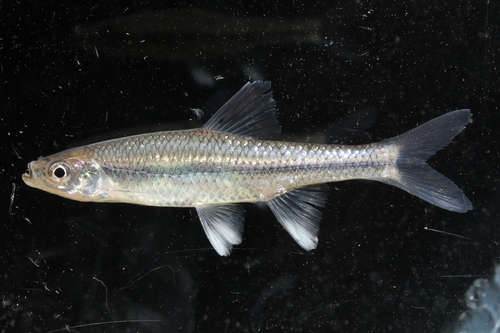
The pugnose minnow (Opsopoeodus emiliae Hay, 1881) has an average lifespan of 3 years. Its diet consists mostly of insects, though it will occasionally consume algae accidentally. When insects are not available, pugnose minnows may eat eggs of other fish or small aquatic crustaceans like brine shrimp. This small silver fish has an average length of 1–2 inches (2.5–5.1 cm), with some individuals growing up to 2.5 inches (6.4 cm) long. It has a forked tail, short pectoral fins, and a small rounded snout. Its most distinctive feature is a lateral line that runs all the way from the tail to the mouth. The pugnose minnow has a strongly superior (upturned) mouth, which indicates it feeds on food located above it in the water column. Its dorsal fin, which holds 9 dorsal spines, is translucent, and the caudal fin is also translucent. There is a black spot at the base of the caudal fin that becomes more prominent in males when they are ready to mate. Breeding males also develop tubercles, which they use to fight for dominance and gain acceptance from females. The pugnose minnow is a freshwater fish native to Canada and the United States, found primarily along the eastern portions of both countries. It can inhabit clear waters as well as slow, turbid waters with abundant debris for hiding. In the United States, it occupies many different types of aquatic habitat: some individuals remain in the clear water where they hatched, while others swim further away to settle in environments with much more silt and clay. Pugnose minnows reproduce from late spring to early summer, laying their eggs under habitat debris, particularly under rocks or logs. Males clear the area under a rock and defend it from other males using the tubercles on their snout. A female must be led to the male’s chosen site, where she investigates the spot while the male repeatedly nudges her with his dorsal fin to stimulate egg spawning. Female pugnose minnows lay adhesive eggs that stick to the underside of the rock. Eggs are laid either individually or in strings, with approximately 120 eggs per clutch. Males and females repeat this spawning process over the course of 6 to 7 days. After all eggs are laid, the female does not participate further in caring for the offspring. Males guard the eggs until they hatch, which takes around 6 days, depending on weather conditions.