About Oplopomus oplopomus (Valenciennes, 1837)
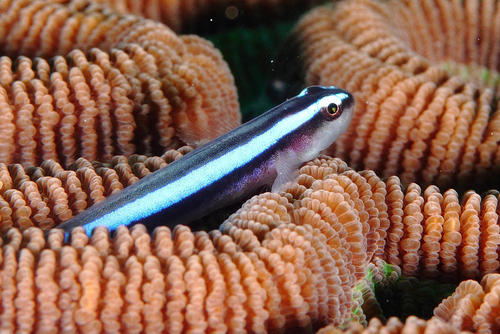
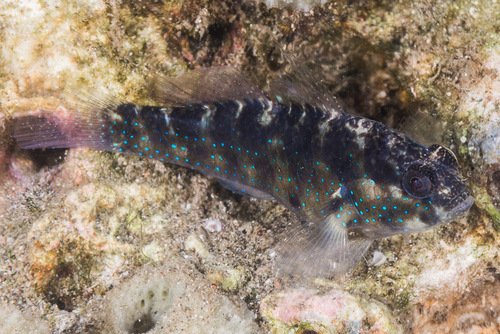
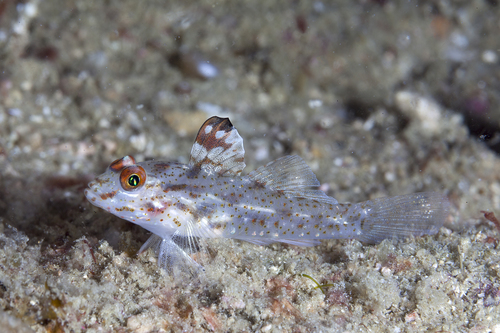
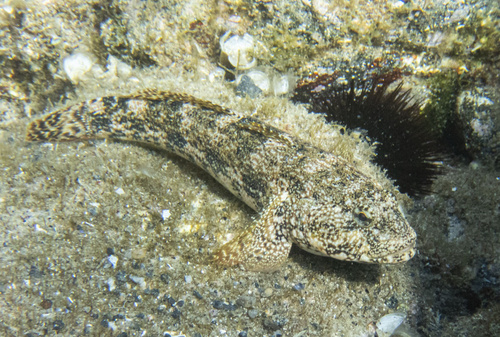
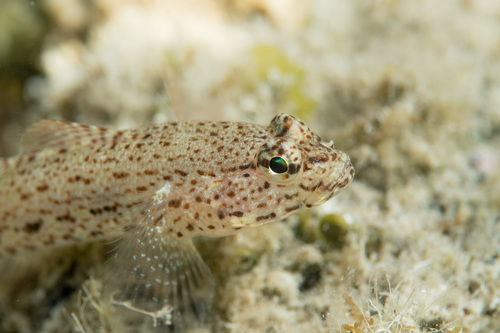
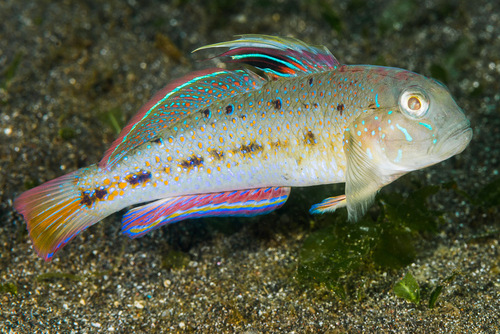
Oplopomus oplopomus, commonly called the spinecheek goby, reaches a maximum total length of 10 centimetres (3.9 inches). It has an elongated body that is compressed from side to side. Its mouth slopes downward, and the lower jaw extends past the upper jaw. Multiple rows of teeth are present in both jaws, and the teeth in the outermost row are enlarged. The lower jaw also holds a pair of curved canine teeth. The eye has a wider diameter than the blunt snout, and an open pore sits just behind the eye. No scales are present on the goby’s head, while scales covering the rest of the body are ctenoid. The first dorsal fin is elongated and separated from the second dorsal fin; both fins have a stiff first spine. The second dorsal fin and the anal fin are roughly equal in size. The pectoral fins are rounded and shorter than the length of the head. The ventral fins are pointed and fused together by a bridge of skin called a frenum. The caudal fin is rounded and around the same length as the head. The dorsal surface of this goby is reddish-green and marked with several small black spots. Short black lines appear on the head, and both the head and body are covered in numerous tiny, iridescent dots in pale blue, violet, and yellow. A row of six longitudinal dark spots runs along the middle of the body’s sides. The fins are yellowish-orange. The first dorsal fin has a slanting violet stripe, while the second dorsal fin is covered in small dark spots. The pectoral fin is also marked with small spots. The base of the anal fin and the rear portion of the ventral fins are black. The caudal fin has a stripe running through its center. Male spinecheek gobies have more intense blue markings than females. Juveniles have more black spots, and fewer yellow and blue spots, than adults. Spinecheek gobies are native to the Indian Ocean and western Pacific Ocean, ranging from East Africa to the Society Islands, and north as far as Japan’s Yaeyama Islands. They live on coral reefs at depths between 1 and 30 metres (3.3 to 98.4 feet).