About Oplismenus undulatifolius (Ard.) P.Beauv.
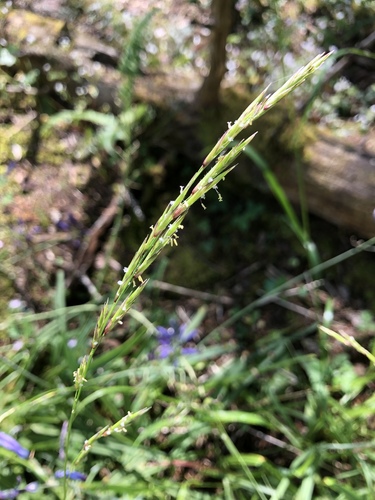
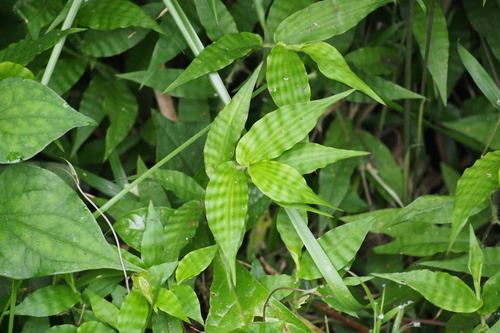
Oplismenus undulatifolius (Ard.) P.Beauv. is a shallow-rooted perennial grass with stolons that can reach several feet in length. The leaves are distinctly crimped or undulating. Leaves of overwintering plants turn brown and die, but new growth begins at the upper nodes of the stolons each spring. In early fall, its sticky awns easily adhere to anything that brushes against them, an effective method of seed dispersal. The entire plant grows 15–50 centimetres (5.9–19.7 in) long. Leaf blades are slightly lanceolate to ovate, measuring 1–7 centimetres (0.39–2.76 in) long and 4–15 millimetres (0.16–0.59 in) wide. Its inflorescence is 2–8 centimetres (0.79–3.15 in) long, and is composed of 5 to 11 cuneate fascicles. Each fascicle is 0.5–1.5 centimetres (0.20–0.59 in) long and holds 2 to 6 spikelets. Like leaf blades, spikelets are lanceolate, and measure 2.5–4 millimetres (0.098–0.157 in) in length. Spikelets can be both glabrous and pubescent, with glumes that bear smooth, sticky awns 7–14 millimetres (0.28–0.55 in) long. The awns of the lower glumes are purple, 5–10 millimetres (0.20–0.39 in) long, and marked with 3 to 5 veins. The lower lemma is herbaceous with 5 to 9 veins, while the upper lemma has 5 veins and bears an awn 2–5 millimetres (0.079–0.197 in) long. The apex of the species has a stout structure 1–2 millimetres (0.039–0.079 in) long. This species produces flowers and fruits from July to November. It grows particularly well in moist, shaded environments across a variety of soil types. In Australia, it grows in shady coastal forests at Coffs Harbour. Within its native range, Oplismenus undulatifolius is a food source for many Lepidoptera species: Elachista kurokoi, Helcystogramma fuscomarginatum, Mycalesis francisca, Mycalesis sangaica, Mycalesis zonata, Palaeonympha opalina, Stigmella oplismeniella, Ypthima akragas, Ypthima baldus, and Ypthima esakii.