About Oplegnathus punctatus (Temminck & Schlegel, 1844)
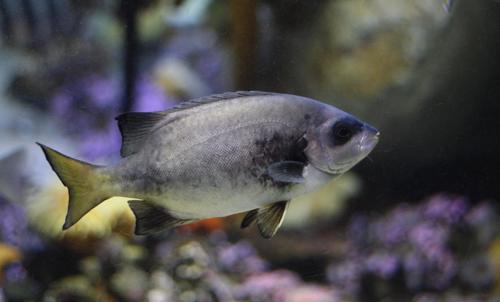
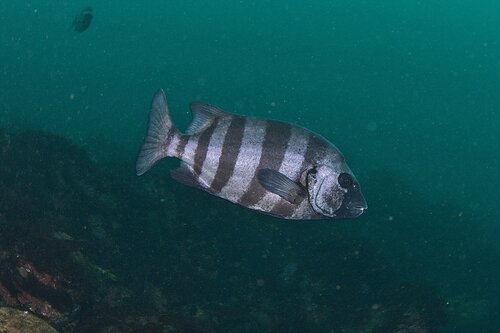
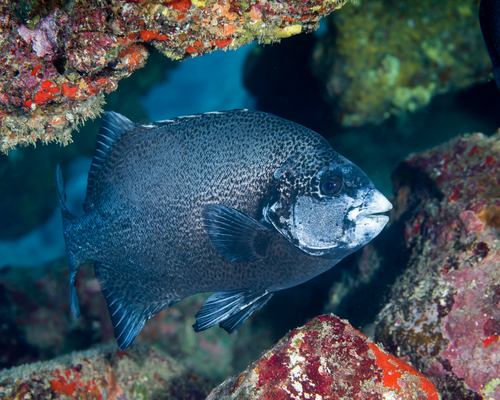
Oplegnathus punctatus, commonly called spotted knifejaw, has a black-brown body covered with irregular black spots. The species has an average body size of around 51 mm (2 in), and the largest recorded individual reaches 0.61 m (2 ft) in total length, with a fork length of 0.46 m (1.5 ft); specimens recorded in northwestern Hawaiʻi have been reported to reach up to 710 mm (28 in) in length. Oplegnathus punctatus has fused beak-like teeth, formed by a continuous series of arrow-shaped dental units surrounded by bone. These dental units shift gradually from the base toward the edge of the jaw over the course of a fish’s life. Early in development, teeth form a thick enamel layer that protects them from damage. Both upper and lower jaws are fused to the jawbone, and any gaps between teeth are filled with calcium. The species has ctenoid scales, which are small rigid plates that grow out of the skin, with spines that project separately from the main body of each scale. Spotted knifejaws are coastal fish that occupy the middle and lower strata of temperate, tropical, and subtropical waters. They prefer to live in rocky or coral reef waters, while juveniles typically stay near drifting seaweed. They inhabit waters between 10 and 100 m (33 and 328 ft) deep, where light absorption by water keeps the environment dark for extended periods. The species is common in the cool northwestern waters of Hawaiʻi, found most frequently near Kauaʻi and Niihau, and also occurs throughout the Main Hawaiian Islands. It is also commonly distributed in the South China Sea, East China Sea, and Yellow Sea. From November to March each year, cold water inflow along the Vietnam coast toward Peninsular Malaysia, centered at 5°N, creates a suitable rocky habitat with abundant drifting seaweed for juvenile spotted knifejaws to attach to. Mature female spotted knifejaws spawn multiple times per breeding season on sandy or gravel bottoms between April and July. Because seawater temperatures are low on China’s northern coasts, most aquaculture rearing of this fish takes place in land-based systems equipped with heating equipment. Growth is stunted when water temperature drops below 15°C, and the optimal temperature range for growth of spotted knifejaw is between 25°C and 30°C. Many studies have focused on the developmental biology and artificial breeding techniques for this species, including research on taxonomy, ecology, and historical observations of organ development during early life stages. Advances in artificial breeding technology for spotted knifejaw have allowed breeding scales to expand. To date, most breeding of this fish in the northern Yellow Sea and Bohai Sea areas of China uses either recirculating aquaculture systems or aquaculture net pens.