About Opisthoncus sexmaculatus (C.L.Koch, 1846)
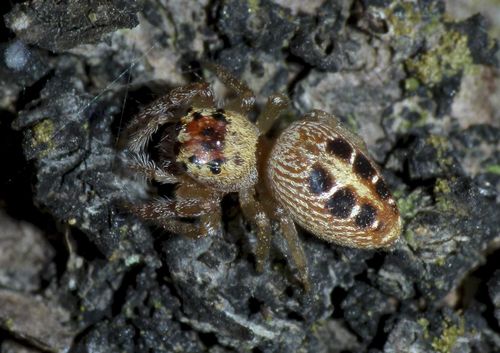
Only the female of Opisthoncus sexmaculatus has been described; the male of this species remains unknown. The female has a round, pale brown cephalothorax, with a dark brown eye field. The cephalothorax is covered with greyish and yellow scales and hairs, while the area surrounding the eyes is almost black. The clypeus is pale brown, and is densely covered with numerous pale scales and setae. The chelicerae are brown; the endites and labium are brown, with yellow anterior margins. The sternum is relatively wide and yellow in colour. The opisthosoma has a distinctive pattern: it is mottled orange, with a longitudinal pale streak and transverse orange stripes separated by almost black patches. It is covered with yellow scales and brownish hairs. The ventral underside of the body is pale, while the spinnerets are almost black. The legs are yellow-brownish in colour. The epigyne has relatively small copulatory openings oriented toward the middle-front. The insemination ducts are moderately long, the walls of the spermathecae are strongly sclerotized, and the accessory glands are rather inconspicuous. This species can be told apart from similar species like O. polyphemus and O. serratofasciatus by the position of its spermathecae and the colour pattern of its abdomen. Opisthoncus sexmaculatus is known only from New South Wales, Australia. Its holotype was collected from "New Holland", an old name for Australia, by collector Preiss.