About Opisthograptis luteolata (Linnaeus, 1758)
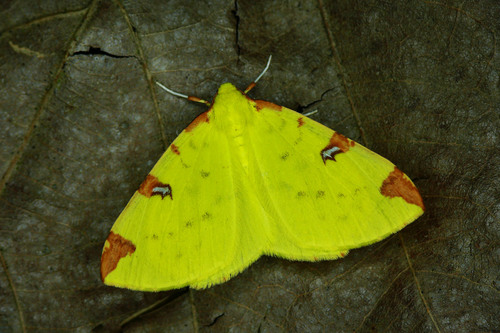
This moth species, Opisthograptis luteolata, is easily recognizable within its range. It has bright yellow wings, with small brown patches along the forewing costa and a small brown-edged white stigma on the forewing. Its wingspan measures 33–46 mm. The name-typical form is the only European species of this genus. It has red-brown costal markings on the forewing at the base, at the discal mark, and in a triangular shape at the apex; it also has faint, irregular grey antemedian and postmedian lines that are interrupted at the veins. The hindwing has a dark discal dot and a faint grey postmedian line. aestiva Vorh. & Müll.-Rutz is a smaller, more deeply colored summer brood form, and it appears to be the main or only form found in Tunis. The aberration flavissima Krulik. is almost entirely yellow, with only faint remnants of the costal markings. The aberration albescens Ckll. has a pure white ground color instead of yellow, and very pale yellow examples have been separated as intermedia Harrison. The aberration niko Chr., as described by Staudinger, is an unusual morph with broad fuscous margins on both wings and a brownish basal area on the forewing; this may be an accidental aberration, as the yellow coloration of this species is highly sensitive to various chemical influences. provincialis Ob. is a pale, weakly marked form from Provence. emaculata Graes. lacks the apical patch on the forewing; it is common in Central Asia and occurs accidentally elsewhere. mimulina Btlr. has a large cell-mark, strong lines, and the two main forewing lines end in prominent red-brown spots on the hindmargin; this form is found in northern India at locations including Dharmsala. This moth sometimes flies during the day but is mainly active at night, and it is attracted to light. The larva is brown or green, has a "horn" on its back, and feeds on a variety of trees and shrubs. Recorded food plants include apple, birch, blackthorn, currant, hawthorn, Prunus, rowan, Amelanchier and willow. Due to its complex life cycle, the species overwinters either as a larva or a pupa. It has a complex ecology: sometimes one brood is produced per year, and sometimes three broods are produced over a two-year period. As a result, adults can be seen in flight any time from April to October. This species is found throughout the Palearctic region and Western Asia.