About Opifex fuscus Hutton, 1902
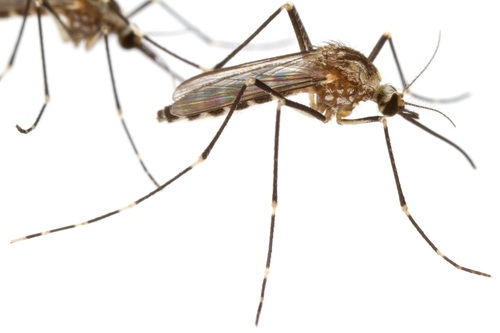
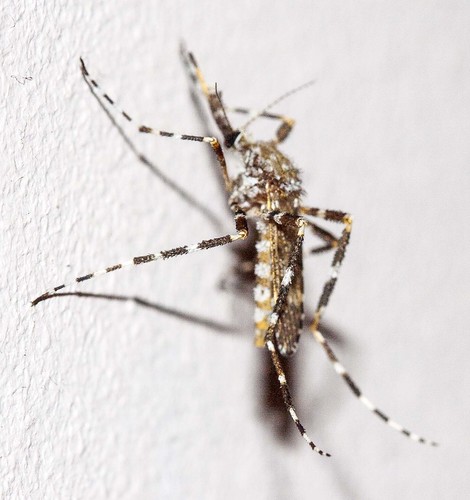
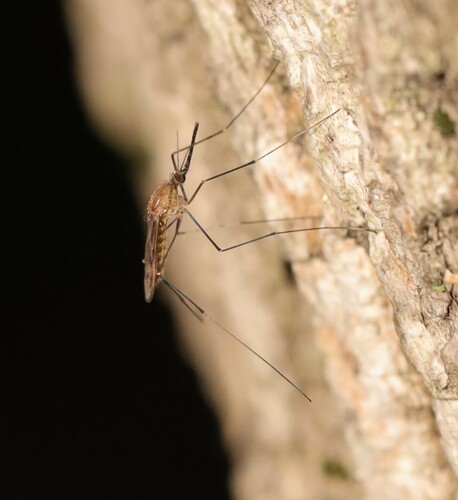
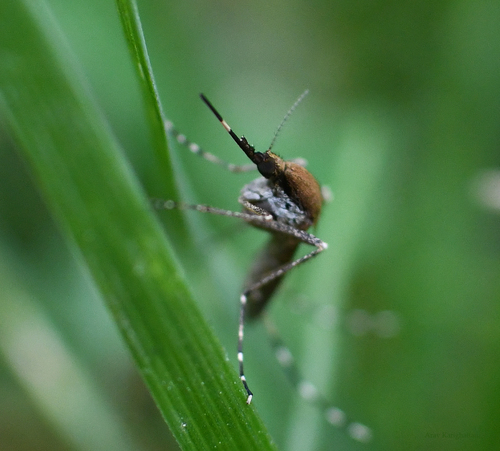
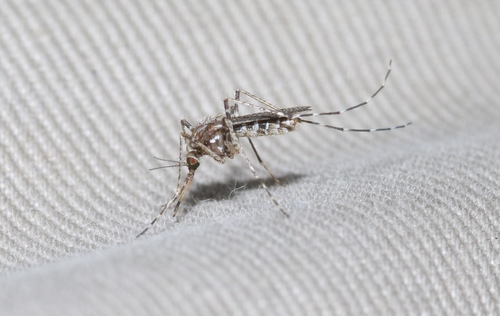
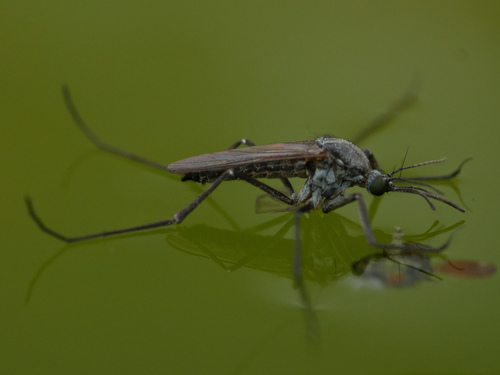
Adult Opifex fuscus Hutton, 1902, a mosquito species endemic to New Zealand, can be distinguished from other New Zealand mosquitoes by specific patterns of abdominal bristles, their antenna shape, and the absence of scales on the upper surface of their head. Adults are stocky, generally greyish, and approximately 5 mm (0.2 in) long. Their antennae are blackish, with three long bristles near the base. The upper head surface lacks protruding scales. Like many other mosquitoes, they have a long proboscis, a straw-like mouthpart used for sucking blood. Their legs are brownish black; males have very long claws on their first pair of legs. The thorax, the middle body segment, is blackish, and its upper surface is covered in gold and black hairs. The abdomen is black-brown, covered in blackish bristles and whitish scales. Water-repellent body hairs allow this mosquito to tolerate being submerged in water. It produces a slight buzzing sound when in flight. This species is found only in New Zealand, occurring along the entire rocky coastline of the North Island and most of the South Island. In the southeast of the South Island, it co-occurs with the exotic species Aedes australis, which also uses rock pools as habitat. It has been suggested that A. australis competes with O. fuscus and has displaced this species in that region. O. fuscus also inhabits nearby small New Zealand islands including the Three Kings Islands, the Mokohinau Islands, and White Island. Populations have also been recorded in the more distant Kermadec Islands and the subantarctic Snares Islands. This species is also known as the salt pool mosquito, and it lives in rocky coastal habitats. Its larvae develop in rock pools located in the spray zone above the high tide line. As ocean water evaporates from these pools, it leaves salt behind, so the pools typically develop high salt concentrations. Larvae live in both permanent and temporary rock pools, which are refreshed by rain and ocean spray. Larvae have also been recorded in pools of freshwater streams and in a horse water trough, though these are not typical habitats. O. fuscus larvae tolerate a wide range of salinities. In field observations, pools containing larvae have been recorded with salinity ranging from approximately 0.40% up to around 9%—the latter is roughly 2.6 times the salinity of normal seawater, which is approximately 3.5%. In laboratory experiments, third and fourth-instar larvae survived step increases in salinity up to 7%, with occasional individuals tolerating up to 10.5% salinity. In an evaporation trial, moulting and pupation stopped at approximately 13% salinity, and all remaining larvae died once salinity reached approximately 16.5%. One separate study reported a single larva surviving in water that was 1.25 times the salinity of seawater. One study found that the cuticle permeability of O. fuscus is much lower than that of mosquitoes that live in freshwater. This lower permeability has been suggested to be an adaptation for surviving the high salinity of their typical salt pool habitat. Adults are frequently observed on or near the rock pools where larvae develop. Males are commonly seen floating on the pool surface. The small crustacean copepod Tigriopus fulvus is often present in the salt pools occupied by this mosquito.