About Ophiura ophiura (Linnaeus, 1758)
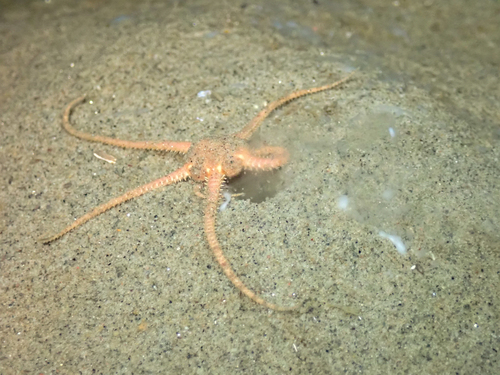
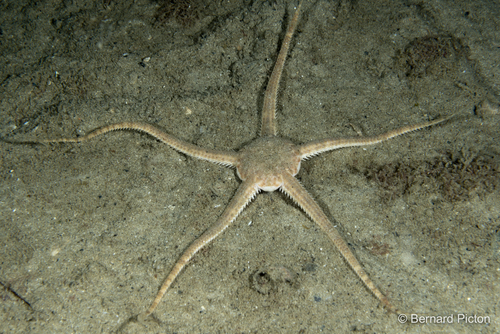
Ophiura ophiura (Linnaeus, 1758) has a circular central disc that can reach up to 35 mm (1.5 inches) wide, plus five radially arranged, narrow arms that each grow up to 140 mm (6 inches) long. Its overall body color is a mottled reddish-brown, with a paler underside. Both the upper and lower surfaces of the central disc are covered with calcareous plates. The arms connect to the top of the disc instead of the disc edge, and additional small articulating plates let the arms bend side to side. Small spines on the arms lie flat against the arm surface. Four larger plates cross the root of each arm; the outer pair of these plates has a comb-shaped edge, with 20 to 30 fine papillae on each. A pair of pores can be seen between the underside plates at the arm root. Five large mouth-shield plates sit on the underside of the disc surrounding the central mouth. Teeth are arranged in a vertical row above each of the five jaws, and there are around five mouth papillae on each side of the jaw. Ophiura ophiura lives on the seafloor of the northeast Atlantic Ocean and the North Sea, ranging from Norway and Sweden south to Madeira and the Mediterranean Sea. It occurs below the low-tide mark in the neritic zone down to around 200 meters depth, and lives on sandy bottoms. It prefers sediments with a fine grain size and approximately 35% mud content. It is a common species; in some years, populations in the North Sea reach 20 to 50 individuals per square meter. The copepod Parartotrogus richardi acts as an ectoparasite of Ophiura ophiura. In the Clyde Sea Nephrops norvegicus (scampi) fishery in Scotland, Ophiura ophiura is one of the unwanted invertebrates caught alongside the starfish Asterias rubens in trawl nets. A study of survival rates for these discarded animals found that uninjured Asterias rubens had a 4% mortality rate, while nearly all Ophiura ophiura died within 14 days even when returned to the sea immediately after capture. A separate study looked at how fast discarded invertebrates sank back to the seafloor and their final outcomes. Ophiura ophiura sank relatively slowly, and was preyed on by seabirds, while fish ate its arms. On the seafloor, a sequence of benthic scavengers fed on the remaining carcasses, with crangonid shrimps and crabs including Carcinus maenas and Liocarcinus depurator being the most common scavengers. After six hours, little remained except crustacean limbs and ophiuroid discs. In baited traps, the crab Pagurus bernhardus was the most common scavenger that fed on Ophiura ophiura.