About Ophisaurus ventralis (Linnaeus, 1766)
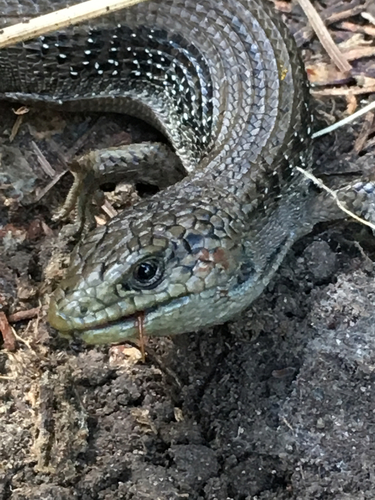
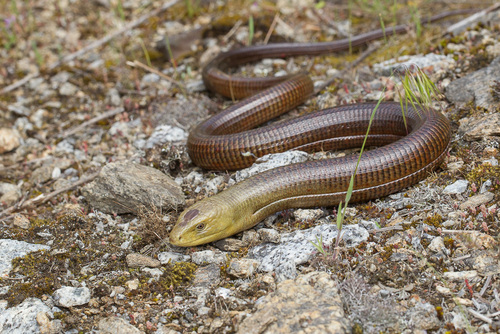
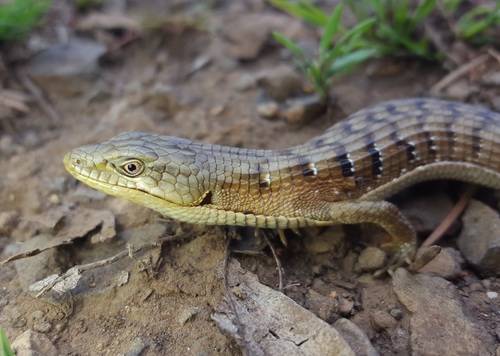
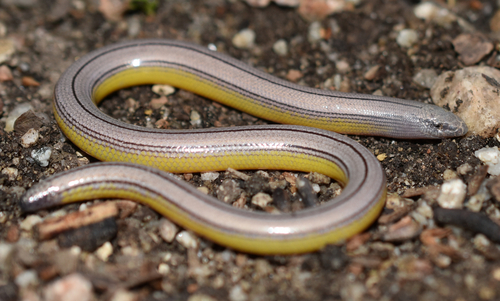
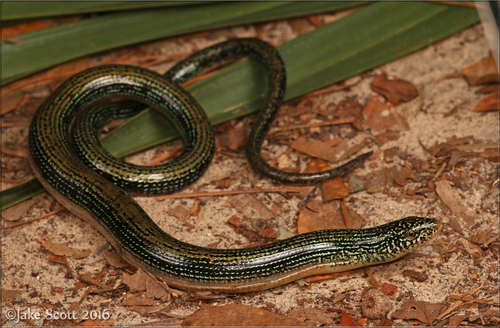
Adult Ophisaurus ventralis reach a total length of 46–108 cm (18–43 in), with a maximum head-body length of only 30.5 cm (12.0 in). This species has 99 or more scales along its lateral groove. No dark longitudinal stripes are present below the lateral groove or under the tail, and there is no distinct mid-dorsal stripe. The tail functions for both balance and defense. The neck is marked with a series of mostly vertical or highly irregular white marks, with white markings on the posterior corners of scales. Palatine teeth are present in this species. Dorsally, older individuals have a pattern of numerous longitudinal dark lines or dashes; occasionally, similar parallel lines cover the entire mid-dorsal area. Older adults may be greenish on the upper body and yellow on the underside; this is the only Ophisaurus species that can have a greenish appearance. Juveniles are khaki-colored and usually have two dark stripes running down the back. Because O. ventralis lacks limbs, it is commonly mistaken for a species of snake. Unlike snakes, it has movable eyelids, external ear openings behind the eyes, and inflexible jaws. The three living North American Ophisaurus species can be distinguished through skeletal analysis by differences in tooth count and skull size. No subspecies of O. ventralis are currently recognized. Eastern glass lizards, the common name for O. ventralis, are common near wetlands and moist soils. Their typical habitat is flatwoods adjacent to wetlands with sandy soils, and they depend heavily on prescribed fire to maintain this habitat. They have also been found in tidal areas such as coastal dunes, since they are resistant to salty conditions. Eastern glass lizards are most active during the day; they forage in open habitats, and also take shelter beneath debris. A 2020 study recorded O. ventralis using a crayfish burrow as habitat in southeastern Mississippi. While various invertebrates and vertebrates are known to use these burrows, this was the first documented case of any lizard species using a crayfish burrow. Limited research has been conducted, so this behavior may be more widespread than currently documented. Direct mortality from prescribed fire is a concern for land managers who use fire as a management tool in eastern glass lizard habitat. O. ventralis is commonly found from extreme southeastern Virginia to southern Florida, and west to Louisiana. It is restricted to the coastal plains of the southeastern United States, with populations bounded by the Mississippi River. Isolated records of its occurrence exist in Oklahoma and Missouri. O. ventralis is oviparous, laying 5 to 15 eggs between late April and mid July. Eggs have an incubation period of 40 to 65 days, and hatch in late summer. Eggs are typically laid under cover or in depressions in sandy or loamy soil. Females will encircle their clutch, but may retreat when approached and generally do not defend their eggs. They will, however, gather scattered eggs back together. The average egg mass is 759 mg (11.71 gr), with an average length of 18 mm (0.71 in).