About Ophisaurus attenuatus Baird, 1880
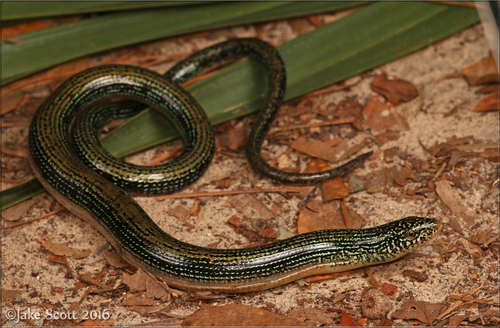
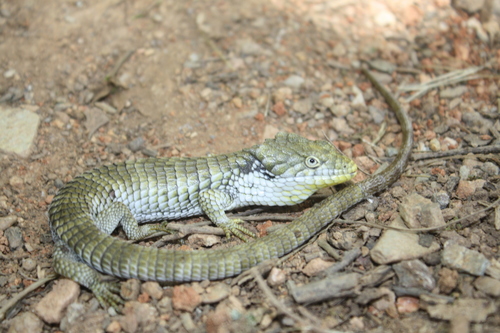
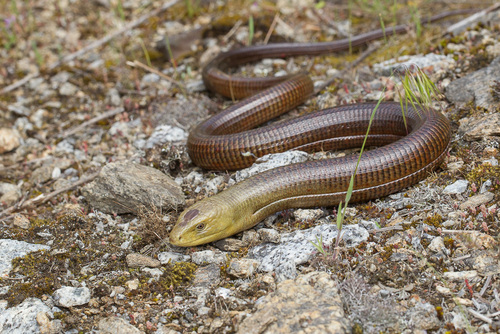
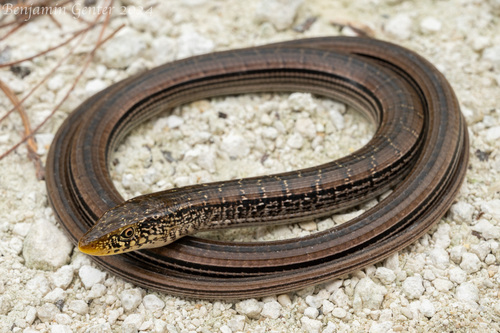
This species, commonly called the slender glass lizard, has a yellow to brown body marked with six stripes plus an additional middorsal stripe. White specks on the center of the lizard’s scales may sometimes form extra light stripes. Adults can reach a total length between 0.56 meters (22 inches) and 0.91 meters (36 inches). This species is closely related to collared lizards. Two-thirds of its total body length is made up by its tail. Each of its scales is supported by an osteoderm, which gives the lizard a hard, stiff body. It has a pointed snout and an indistinct head. Males and females grow to a similar size. An individual’s markings tend to fade as it ages. Unlike snakes, slender glass lizards have both eyelids and external ears. They struggle to move across smooth surfaces because they lack the large belly scales and associated specialized muscles that snakes have. Their body is less flexible than a snake’s body, and they have differently shaped scales than snakes. Ophisaurus attenuatus is endemic to the midwestern and southeastern United States. It inhabits prairies, old fields, and open woodlands, and is often found near water. It can also occasionally be found in longleaf pine forests and areas of human-made debris. Mating typically occurs every other year in May. Females lay between 5 and 15 oval eggs in late June or July. Eggs are laid under covering objects such as logs or boards. The mother remains with the eggs throughout their incubation. Incubation lasts between 50 and 60 days, with most eggs hatching after 53 days between August and October. Newly hatched lizards are 10–13 cm (3.9–5.1 in) long and are difficult to locate. Individuals reach sexual maturity at 3 to 4 years of age.