About Ophiothela mirabilis (Verrill, 1867)
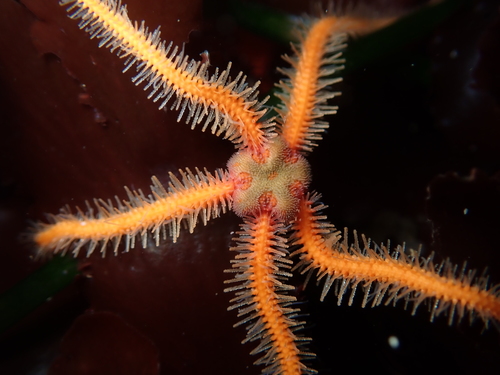
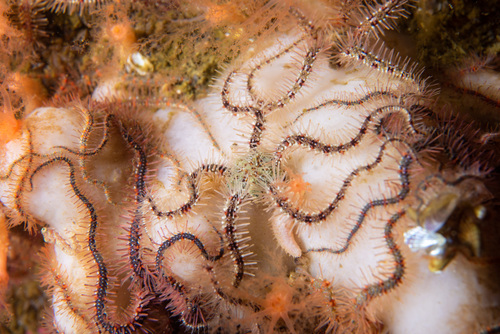
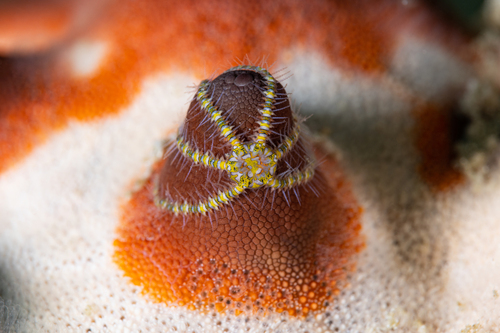
Ophiothela mirabilis (Verrill, 1867), the species formerly known as Ophiothela danae, which is now considered a junior synonym of this species, is a very small brittle star that rarely grows larger than 1 cm when including its arms. It usually has 6 arms, but because it reproduces asexually through division (a process called scissiparity), its body shape is often very irregular. This irregularity can appear as one half of the body being more developed than the other, having only 4 or 5 arms, or conversely having 7 or 8 arms. Its coloration is extremely variable; this variation led researchers to believe for a long time that it was a complex of multiple separate species. Color forms include solid orange, or white mottled with bright colors, most notably yellow and blue, with ringed arms. All individuals have arms covered in delicate, translucent, thorny spines, and the arms are flexible in all directions. The jaws hold clusters of well-developed tooth papillae at the apex, but not on the sides. There are no mouth papillae, and a second pair of tube feet is located inside the mouth edge. The dorsal surface of the central disc is covered with spines and thorny tower-like structures. Ophiothela mirabilis occurs at latitudes between 33° South and 38° North. It is native to three marine realms: the Tropical Eastern Pacific, Temperate North Pacific, and East Indo-Pacific. In recent times, invasive populations of Ophiothela mirabilis have been observed in two additional marine realms: the Tropical Atlantic and Temperate South America. The first recorded occurrence of this species in the Atlantic Ocean was reported off the coast of Rio de Janeiro, Brazil in 2000. Shipping activity is cited as the most likely cause of the species’ invasive spread, because Ophiothela mirabilis occurs in high concentrations close to ports. Non-native populations also show higher survivability than native populations, which is likely the result of harsh conditions and increased competition experienced during transport. More research is needed to gather current population data for this species and assess its potential for future range expansion. Ophiothela mirabilis lives on host organisms in shallow waters. Individuals do not always remain on their original host for long periods, and may leave one host to settle on another. Octocorals are the group of organisms most frequently and densely colonized by this brittle star, but Ophiothela mirabilis is known to colonize over 20 different host species, including sea sponges, other cnidarians, bryozoans, sea urchins, and algae. This species requires specific aquatic conditions to inhabit an area: a mean calcite concentration of 0.53 × 10⁻⁴ to 0.051 mol.m−3, a mean surface sea temperature above 20.23 °C, a chlorophyll concentration between 0.004 and 1.64 mg/m3, and a mean water pH level above 7.64. Many fissiparous brittle star species can reproduce both asexually and sexually, but asexual reproduction is the primary method for most of these species, including Ophiothela mirabilis. One study published in the Marine Biodiversity Journal found no evidence of sexual reproduction in Ophiothela mirabilis, as no gonads were observed across multiple studied populations. This species reproduces asexually through fragmentation: a parent individual splits into fragments, and each fragment eventually develops into a fully mature individual. Echinoderms use a specific form of fragmentation called fissiparity, in which some species intentionally split their body through autotomy. Autotomy, also called self-amputation, is most often a defensive mechanism that lets an organism detach a body part to escape high-stress situations like predation. This process can also occur accidentally for Ophiothela mirabilis: when hooking onto sponges or gorgonians, the brittle star is exposed to erratic movements that can cause its disc tissue to separate. Ophiothela mirabilis can regenerate a full mature individual, complete with a whole disc, arms, and organs, from a single fragment in less than a month. This reproductive method allows the species to spread rapidly and become abundant across invaded ecosystems. Ophiothela mirabilis follows the general life cycle pattern of other brittle stars, but its full life cycle has not been thoroughly studied, and further research on this topic is needed. Brittle stars typically have a pelagic planktonic phase suspended in the water column, and a benthic phase on the seafloor or attached to a substrate like bryozoans, tunicates, sponges, or corals. The first stage of Ophiothela mirabilis’ life cycle is the planktonic larval stage, during which larvae are free-swimming and drift along with ocean currents. Studies note that these larvae have a bilaterally symmetrical body plan and undergo major morphological changes during development. Larvae feed on planktonic organisms, and have a ciliated band of tiny hairs that helps them move and capture food. This larval stage can last for several weeks or months, depending on local environmental conditions. Once larvae reach a specific size, they undergo metamorphosis and settle onto a suitable substrate to begin their sessile juvenile stage. Metamorphosis in brittle stars involves the breakdown of the ciliated band, growth of tube feet and arms, and development of a hard exoskeleton to protect the juvenile as it transitions to a sessile lifestyle. During the juvenile stage, individuals attach themselves to the substrate using their arms and secrete a protective hard exoskeleton that defends them from predators. Juveniles are also capable of filter feeding, using their arms to catch planktonic food. After several months, juveniles reach maturity and develop into fully grown adult forms that can reproduce to continue the life cycle. Adult Ophiothela mirabilis are not sessile, and are fully mobile. There is an additional developmental stage called vitellaria that occurs between the planktonic phase and metamorphosis. This stage is defined by the presence of ciliated bands and tube feet, which help the vitellaria move and explore the surrounding environment before settling. This allows the developing brittle star to find a suitable location to attach to the seafloor and grow into a mature adult.