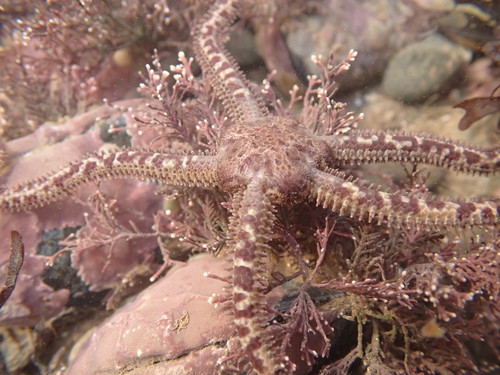
About Ophiopholis aculeata (Linnaeus, 1767)
Ophiopholis aculeata has a central pentagonal disc that can reach up to 2 cm (0.8 in) in diameter, and is distinctly separated from its five robust, twisted arms. These arms are four times as long as the disc is wide. The mouth is located on the oral, or underside, of the disc, and is surrounded by five toothed jaws. The aboral, or upper, side of the disc has a granular texture, and a pair of large scales called radial shields covers the base of each arm. The radial shields are covered with small spines that hide the scales underneath. The many-jointed arms are covered with additional scales on both their oral and aboral surfaces. On the aboral surface, there is a regular row of oval scales, each surrounded by smaller scales. Each arm segment has six or seven stout spines, one of which is a short, hooked spine. The colour of this brittle star varies: it is often reddish or variegated, and sometimes purplish. The central scales on the disc often form a ten-pointed star pattern, and the arms usually have darker coloured bands. This brittle star has a circum-boreal distribution. In the northern Atlantic Ocean, it is common around Iceland, Spitzbergen and Norway, with its range extending south to the North Sea. On the eastern coast of North America, its range stretches from Greenland south to Long Island. In the Pacific Ocean, it can be found from Japan and the Bering Sea south to California. It generally lives on rocky substrates, and tends to hide inside shells, as well as in hollows and crevices. It most commonly occurs at depths of less than 300 m (1,000 ft), though individuals have been found as deep as 1,880 m (6,200 ft).

