About Ophiophagus hannah (Cantor, 1836)
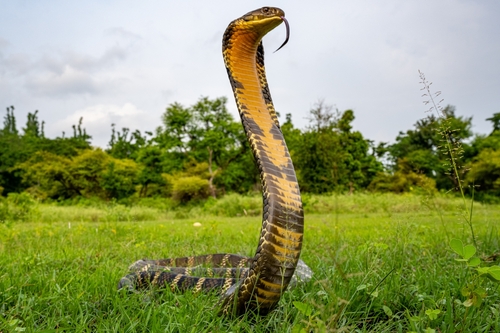
The king cobra, scientifically known as Ophiophagus hannah (Cantor, 1836), has olive green skin with black and white bands across its body that converge toward the head. Its head is covered by 15 large, drab-coloured scales (called shields, consistent in their presence across all individuals) that are edged in black. It has a rounded muzzle, a black tongue, two fangs, and 3–5 maxillary teeth in the upper jaw, plus two rows of teeth in the lower jaw. Its nostrils sit between two shields, and its large eyes have a golden iris and round pupils. The king cobra’s oval hood is covered in smooth olive green scales, with two black spots between the two lowest scales on the hood. Its cylindrical tail is yellowish green on the upper side and marked with black. It has a pair of large occipital scales on the top of the head, 17 to 19 rows of smooth oblique scales on the neck, and 15 rows of these scales on the body. Juvenile king cobras are black with chevron-shaped white, yellow or buff bars that point toward the head. Adult king cobras measure 3.18 to 4 m (10.4 to 13.1 ft) long; the longest known individual on record measured 5.85 m (19.2 ft). Ventral scales are uniformly oval shaped, and dorsal scales are arranged in an oblique pattern. The species is sexually dimorphic: males are larger, and particularly paler, during the breeding season. Males captured in Kerala measured up to 3.75 m (12.3 ft) long and weighed up to 10 kg (22 lb), while captured females reached a maximum length of 2.75 m (9 ft 0 in) and a maximum weight of 5 kg (11 lb). The largest known wild king cobra, captured in Thailand, measured 5.59 m (18 ft 4 in) long. King cobras differ from other cobra species in size and hood shape: they are larger overall, and have a narrower, longer stripe on the neck. The king cobra has a wide distribution across tropical Asia, occurring at elevations up to 2,000 m (6,600 ft). Its range extends from the Terai region of India and southern Nepal, through the Brahmaputra River basin of Bhutan and northeast India, south through Bangladesh, Myanmar, southern China, Cambodia, Thailand, Laos, Vietnam, and into the maritime Southeast Asian countries of Malaysia, Singapore, Indonesia and the Philippines. In northern India, it has been recorded in Garhwal, Kumaon, and the Sivalik hills and terai regions of Uttarakhand and Uttar Pradesh. In northeast India, it is recorded in northern West Bengal, Sikkim, Assam, Meghalaya, Arunachal Pradesh, Nagaland, Manipur and Mizoram. In the Eastern Ghats, it occurs from Tamil Nadu and Andhra Pradesh to coastal Odisha, and is also found in Bihar and southern West Bengal, especially the Sundarbans. In the Western Ghats, it has been recorded in Kerala, Karnataka and Maharashtra, and also occurs in Gujarat. It is also present on Baratang Island in the Great Andaman island chain. Its furthest confirmed western distribution reaches extreme western India and eastern Pakistan, near Lahore and Palanpur. These populations were once thought to originate from introduction by snake charmers or accidental transport along rivers, but they are now more widely considered to be natural. However, it remains uncertain whether any persistent populations still exist in this western area. Like other snakes, the king cobra collects chemical information using its forked tongue: the tongue picks up scent particles and transfers them to the Jacobson’s organ, a sensory receptor located in the roof of its mouth. After envenoming its prey, the king cobra swallows prey whole. Its flexible jaws allow it to swallow prey much larger than its own head. It is generally considered diurnal, as it hunts during the day, though rare sightings at night have been recorded. Female king cobras are gravid for 50 to 59 days. The king cobra is the only snake species that builds a nest from dry leaf litter, with nesting activity occurring from late March to late May. Most nests are built at the base of trees, reaching up to 55 cm (22 in) high at the centre and measuring 140 cm (55 in) wide at the base. Nests are made of multiple layers and most have a single chamber where the female lays her eggs. Clutch size ranges from 7 to 43 eggs, with 6 to 38 eggs hatching after an incubation period of 66 to 105 days. Nest temperature is not constant, and varies from 13.5 to 37.4 °C (56.3 to 99.3 °F) depending on elevation. Females remain guarding their nests for between 2 and 77 days after laying. Hatchlings measure between 37.5 and 58.5 cm (14.8 and 23.0 in) long and weigh 9 to 38 g (0.32 to 1.34 oz). King cobras are capable of facultative parthenogenesis, with the mechanism being a variation of meiosis called terminal fusion automixis, in which meiotic products formed during the anaphase II stage of meiosis fuse together. The venom of king cobra hatchlings is just as potent as the venom of adult king cobras. Hatchlings may have bright distinct markings, but these colours typically fade as the snake matures. Hatchlings are alert, nervous, and highly aggressive when disturbed. The average lifespan of a wild king cobra is approximately 20 years.