About Ophionereis schayeri (Müller & Troschel, 1844)
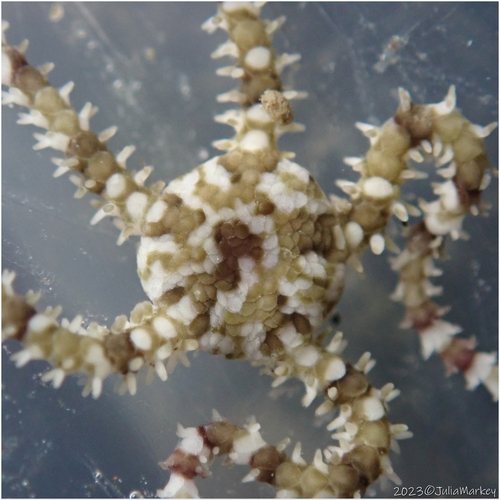
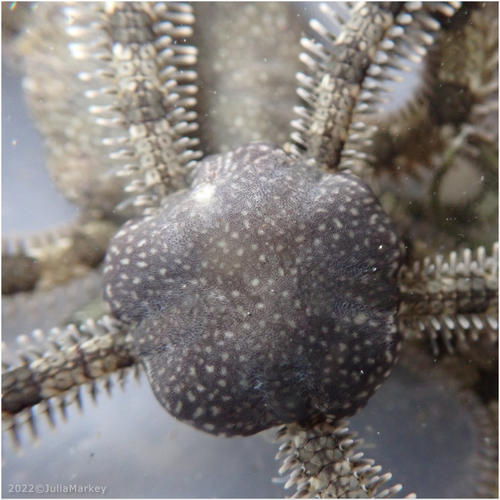
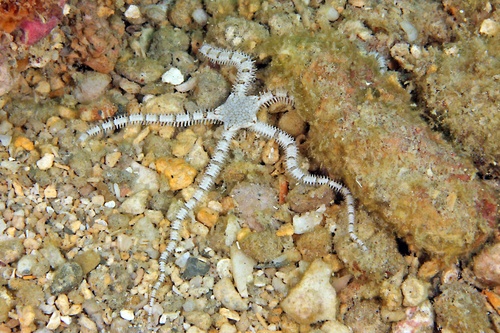
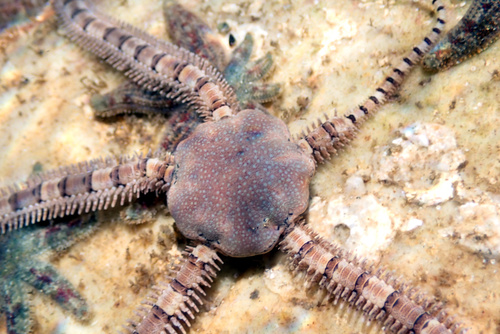
Ophionereis schayeri, commonly known as Schayer's Brittle Star, has a central disk that grows up to 2.5 centimeters wide, and its arms can reach 15 centimeters in length. This species is a filter feeder that sifts through sand and mud on the ocean floor to consume detritus and plankton. At night, individuals extend their arms from under boulders to scavenge for additional food.
Schayer's Brittle Star is found along the coast of Australia, including the waters off New South Wales, Victoria, South Australia, Western Australia, and Tasmania. It is the largest and most common brittle star species found near Sydney. It occurs in habitats ranging from the inter-tidal zone down to 180 meters below sea level, and is often found under boulders in tidal areas. When exposed to light, it moves quickly away to avoid illumination. To reduce exposure to high temperatures, O. schayeri forms clusters under boulders in rocky reef habitats. Like many tide pool-inhabiting species, O. schayeri may be particularly susceptible to the increased ocean temperatures and acidification caused by climate change.
Like all brittle stars, Schayer's Brittle Star goes through multiple metamorphic changes over its life cycle, shifting from planktotrophic development to brooded lecithotrophic development. The earliest larval form is bilaterally symmetrical, with a ciliated band wrapping around its body. This larva develops into a vitellaria larva, which is bordered by ciliary ridges. The vitellaria larva soon grows juvenile tube feet and ventral skeletal plates. The full metamorphic process transforms the body from bilateral symmetry to radial symmetry, the body plan shared by all members of the phylum Echinodermata (Selvakumaraswamy & Byrne, 2004).
This evolutionary shift from planktotrophic to lecithotrophic development is associated with increased maternal reliance, and lecithotrophic development evolved alongside the production of larger eggs. Both of these evolutionary adaptations led to increased triglyceride content in the species' eggs. The effect of this increased triglyceride level in eggs is still currently under research (Inke et al, 2006).