About Ophionereis annulata (Le Conte, 1851)
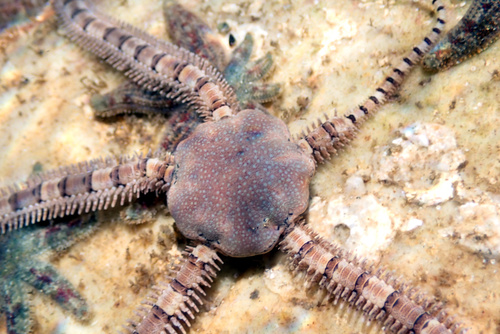
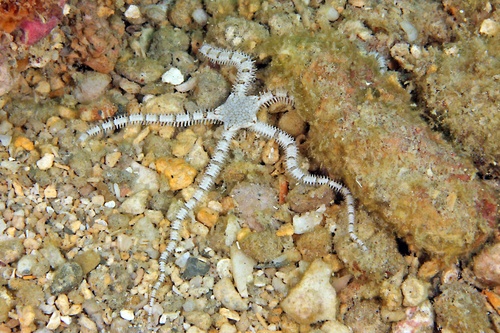
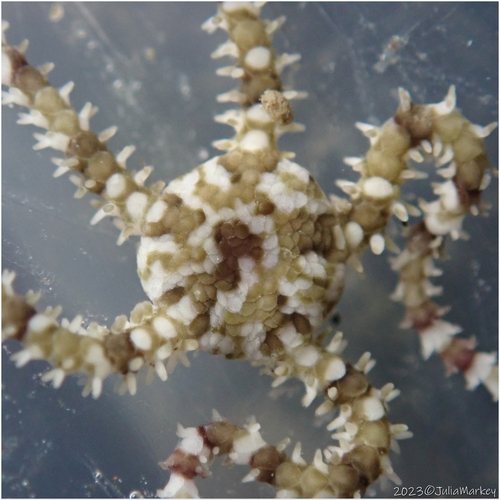
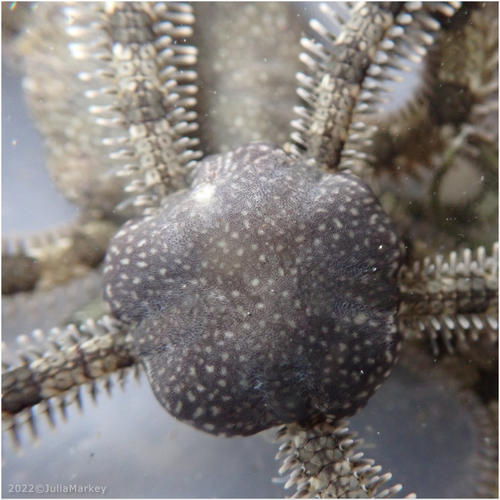
Commonly known as the banded brittle star, Ophionereis annulata (Le Conte, 1851) has five long, flat arms, also called radii. The arms feature distinct dark gray-brown bands, and each band is bordered on both sides by a thin white stripe or white blotching. The exact shape and color of the bands vary between individual organisms: bands can be oval, diamond-shaped, or rectangular, and come in a range of gray-brown shades. The organism's central body disc is typically circular, with a light to medium gray-brown base color speckled with small white dots. The edge of the disc is scalloped between each arm; when this scalloping is more pronounced, the disc may take on a pentagonal or star shape. Juvenile banded brittle stars look similar to adults, but have thinner, more flexible arms. The banded brittle star is found in the eastern Pacific Ocean, along the coasts of North and Central America, ranging from Santa Barbara, California, down to Ecuador, and also occurs in the Galapagos Islands. It lives in the mid- to low intertidal zone, residing under rocky overhangs, within algae, or in sandy pools. Juveniles are most often found in sponge or barnacle beds. The banded brittle star reproduces sexually. In their larval stage, banded brittle stars are extremely small and planktonic, similar to the larvae of other echinoderms, and have a barrel-like shape. Unlike many echinoderm larvae, however, banded brittle star larvae get their nutrition from yolk, classifying them as vitellariae. They do not use their bands of hair-like cilia to catch and consume food particles. As they develop, banded brittle star larvae grow vestiges of the skeletal structures that are characteristic of feeding ophiopluteus larvae. This shows that yolk-dependent vitellariae like those of the banded brittle star evolved from ophiopluteus larvae, rather than being a separate, divergent type.