About Ophiognomonia clavigignenti-juglandacearum (V.M.G.Nair, Kostichka & J.E.Kuntz) Broders & G.J.Boland
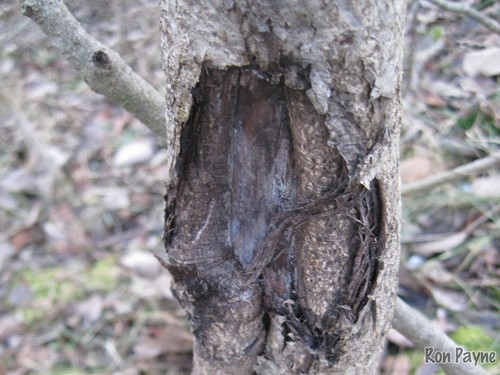
Ophiognomonia clavigignenti-juglandacearum is a mitosporic fungus that causes butternut canker, a lethal disease of butternut trees (Juglans cinerea). It occasionally parasitizes other members of the genus Juglans, and very rarely infects other related trees including hickories. This fungus is found across North America, and infects up to 91% of butternut trees, potentially threatening the long-term survival of butternut as a species. The primary host of O. clavigignenti-juglandacearum, butternut, grows in mixed hardwood forests across central North America, ranging from New Brunswick to North Carolina. The pathogen was identified as an invasive species in 1967. It was first discovered in Wisconsin, but has since spread to other U.S. states and into Canada, and has led to butternut being classified as an endangered species in Ontario. Its native origin is unknown, but it is thought to possibly come from Asia, as Asian walnuts show resistance to this disease. The United States Forest Service found that 84% of all butternuts in Michigan and 58% of all butternuts in Wisconsin were affected by the fungus. Later surveys conducted by the Wisconsin Department of Natural Resources found that 91% of all living butternut trees in Wisconsin were diseased or cankered. In Virginia and North Carolina, the total butternut population has dropped from 7.5 million to 2.5 million. Ophiognomonia clavigignenti-juglandacearum produces spores asexually, and its sexual reproductive form has never been observed. Pycnidiospores are released during rainy weather. When spores come into contact with tree wounds or broken branches, they germinate and penetrate deep into the tree to form cankers. Infection hyphae typically grow intracellularly through parenchyma phloem, but can also grow intercellularly through uni- and multicellate xylem ray cells and parenchyma cells. Over time, the fungus produces stromatal mycelial mats and mycelial pegs. Stroma mats produce uni- or multilocular pycnidia. Inside these pycnidia are branched and unbranched conidiophores that carry two-celled pycniospores, which are later ejected from the pycnidial ostiole. The stroma also produces pegs made of interwoven mycelium. These pegs put pressure on the outer peridium of the host tree bark, which exposes the pycnidia located below the bark. These pegs also produce pycnidia that are smaller than the pycnidia found in the stroma. Despite their difference in size, the spores produced by both types of pycnidia are identical.


