About Ophioglossum vulgatum subsp. vulgatum
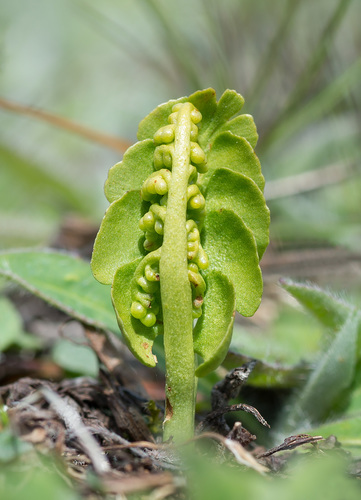
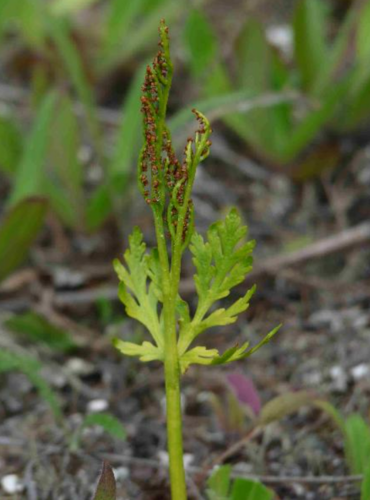
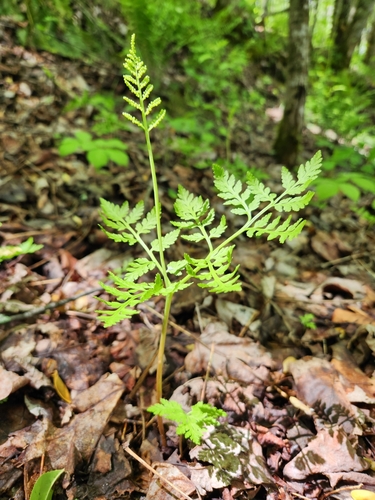
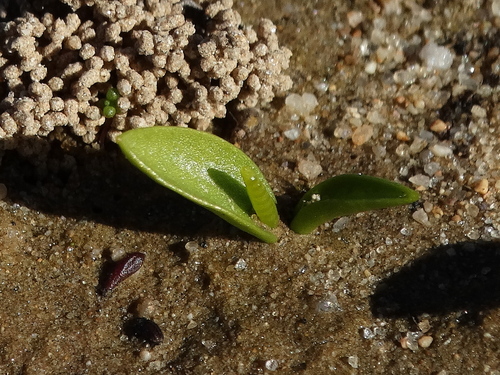
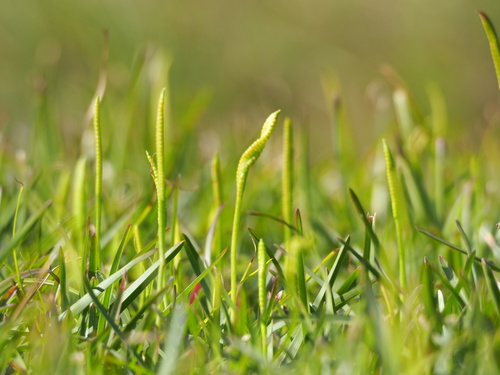
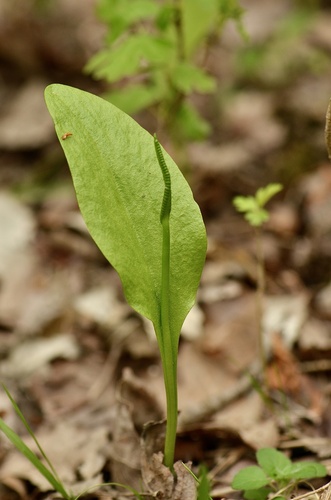
Ophioglossum vulgatum subsp. vulgatum is a perennial fern that grows from a rhizome base, reaching 10–20 cm tall, and rarely up to 30 cm. Its frond is split into two distinct parts: a rounded diamond-shaped leaf blade 4–12 cm long, and a narrow, unbranched spore-bearing spike. Leaf blades are ovate with smooth, toothless edges. The spore spike has between 10 and 40 segments on each side. This subspecies has a wide scattered native distribution, ranging from temperate to tropical Africa, and across the temperate Northern Hemisphere including Europe, northeastern North America, temperate Asia, and Eurasia. This small, easily overlooked plant can grow alone in unimproved pastures, rock crevices, and grassy path sides, but can also form colonies of hundreds of individuals in sand dunes. Most populations across the world tend to be calciphiles that prefer calcium-rich soil, but in Finland the subspecies instead grows on seashores. Finland has very few naturally occurring lime-rich habitats, but the post-glacial rebound that exposes new land from the sea creates suitable equivalent habitat here: newly risen land near Finnish coasts is typically open, fairly bare, neutral in pH, and contains mineral salts that match the plant's needs. It can reproduce both vegetatively and sexually. Vegetative reproduction occurs through new buds that sprout from the rhizome, allowing the plant to form dense patches. Sexual reproduction happens via spores. In European traditional folk medicine, the leaves and rhizomes of this plant were applied as a poultice to treat wounds; this preparation was sometimes called "Green Oil of Charity". A tea brewed from the plant's leaves was also used as a traditional European folk remedy to treat internal bleeding and vomiting.