About Ophioglossum lusitanicum L.
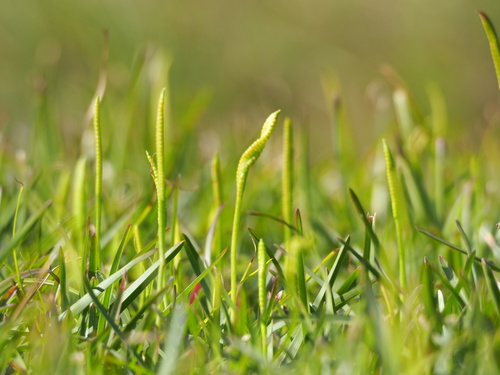
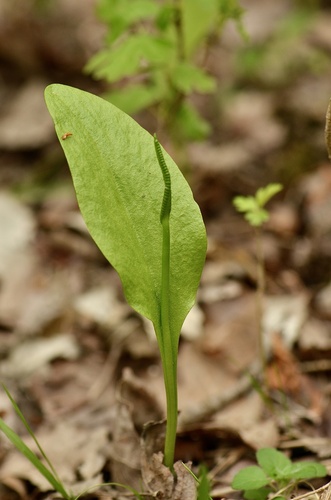
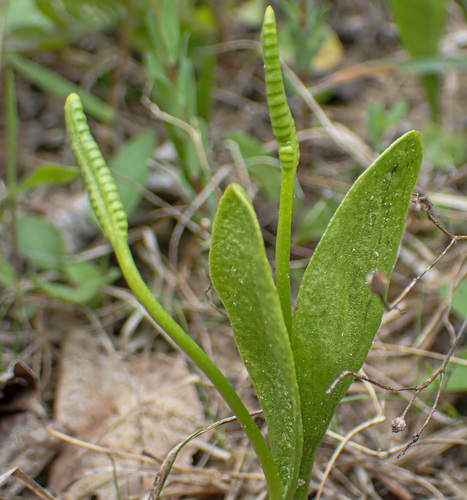
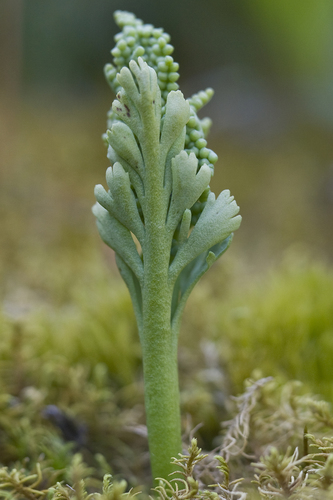
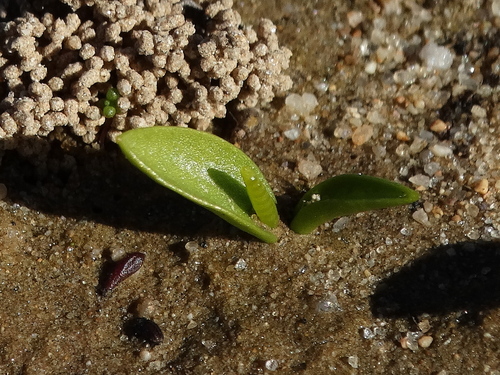
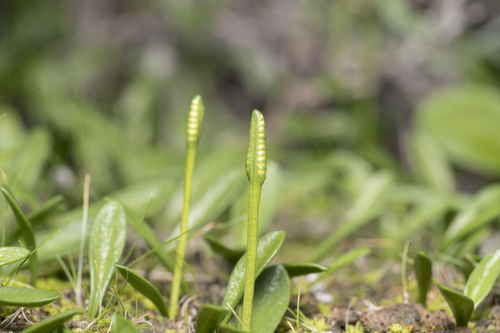
Ophioglossum lusitanicum L. is a small winter annual fern. It has a single simple sterile blade attached to a spike-like fertile blade, which holds between three and eight sunken sporangia on each side. The entire plant rarely grows taller than 2 cm, and this species has a chromosome count of 2n = 250–260. This fern is native to areas bordering the eastern North Atlantic Ocean: this includes Mauritania, Macaronesia excluding Cape Verde, Morocco, Portugal, France, and extends as far north as the Isles of Scilly and Channel Islands. It is also native to every country bordering the Mediterranean, and the Caucasus region, with confirmed records of occurrence in India and Vietnam. In Britain, its distribution is limited to one small area of coastal heath on St Agnes, Isles of Scilly. It was first discovered at this site by John Raven in 1950, where it grows in short turf on Wingletang Down. Some of its colonies here are threatened by increasing growth of competitive plants including common gorse (Ulex europaeus), common bramble (Rubus fruticosus), and other grasses. In Britain, Ophioglossum lusitanicum is listed on Schedule 8 of the Wildlife and Countryside Act 1981, and its British population occurs within a designated Site of Special Scientific Interest (SSSI). As a winter annual species, it requires a warm winter environment. In its British populations, it prefers thin, unshaded, peaty soils located in south-facing sites.