About Ophiodon elongatus Girard, 1854
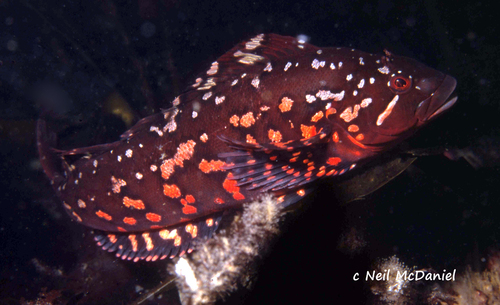
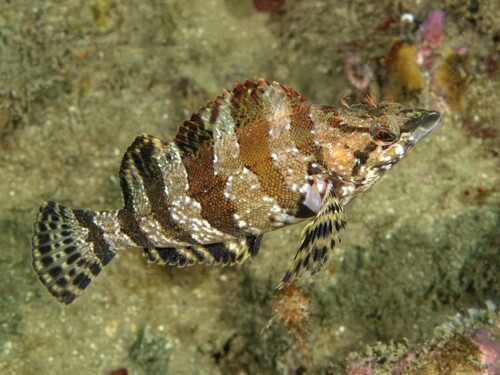
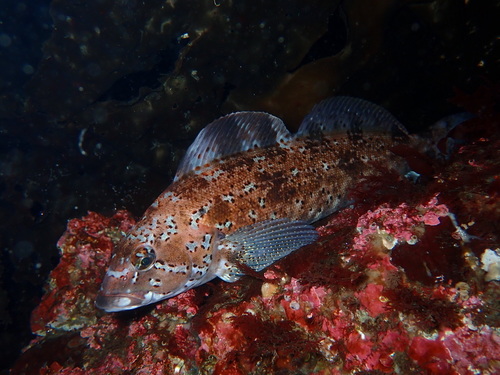
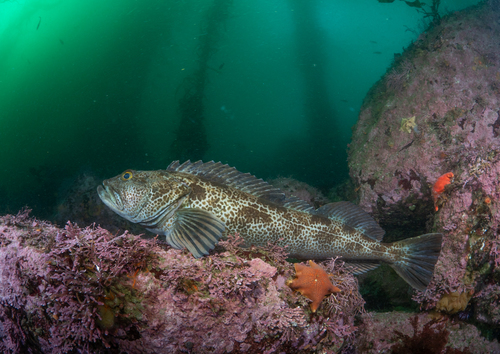
This species, commonly called lingcod, has scientific name Ophiodon elongatus Girard, 1854. Lingcod have multiple variations in appearance. Their backs are colored dark gray, blue, brown, or green, and sometimes have copper-colored mottling or spotting on the upper back. Their bellies are typically lighter than the rest of the body. Lingcod usually have a large head and large mouth, where the upper jaw extends backward past the eyes. They have 18 large, sharp canine-like teeth. Their bodies follow a fusiform body plan, which allows their primary movement to be quick, short bursts. The head is unscaled, and has a cirrus above each eye. The lateral line is prominent and white, and the entire body is covered in cycloid scales. The dorsal fin is made up of both spines and rays, and is split by a notch. The anal fin contains 3 spines. Lingcod do not have a swim bladder. They grow relatively quickly, and can reach up to 5 feet (152 centimeters, 60 inches) in length and 39 kilograms (86 lb) in weight, though individuals weighing as much as 59 kilograms (130 lb) have been reported.
Ophiodon elongatus is native to the west coast of North America, ranging from the Shumagin Islands in the Gulf of Alaska to Baja California, Mexico. They live on the ocean bottom, with most individuals occupying rocky areas at depths between 10 and 100 metres (33–328 ft), but have been found as deep as 475 m (1,558 ft). They are most abundant near British Columbia, Canada, and Washington, USA. Tagging studies show that lingcod are largely a nonmigratory species, with colonization and recruitment only taking place in localized areas. Within their range, there are two separate stocks whose status is maintained by NOAA Fisheries: the Northern Pacific stock and the Southern Pacific stock. Lingcod shift their habitat as they move through different life stages, a pattern called an ontogenetic shift. Larval stage lingcod typically live near the ocean surface. Juvenile lingcod live on sandy ocean bottoms near shore, among eelgrass or kelp beds. More specifically, year 1 lingcod (individuals 25 cm (9.8 in) or shorter) live in homogeneous soft sediment in low-relief areas to avoid predation from adult lingcod. Year 2 lingcod (individuals 25–45 cm (9.8–17.7 in) in length) are usually found near alternating sizes of rock substrates with mixes of moderate and low relief, but still stay in generally shallow water. As lingcod reach adulthood, they move to more rocky habitats or into beds of seaweed, kelp, and eelgrass, which offer abundant food. Year 3+ lingcod (individuals 50 cm (20 in) or longer) are strongly associated with hard substrates like rocky reefs, and also generally live in deeper water. Lingcod have a narrow home range and display territorial behavior, which helps them return to the same reef to spawn. Only female lingcod migrate seasonally to spawn; males prefer to stay in the familiar habitat where they were born. In some cases, immature lingcod have been recorded migrating more than 97 km (60 mi). Females move to shallower water to lay their eggs.
Lingcod can live more than 20 years. On average, males live up to 14 years, and females live up to 20 years. Starting in November, male lingcod migrate to nearshore spawning grounds and establish territories. Interannual nest fidelity with high site precision has been recorded in this species, one of the first recorded examples of this behavior in temperate marine fish. This behavior also shows that male nest selection is part of prespawning mate attraction behavior. Spawning usually happens at night, and occurs annually between January and March. A female can lay up to 500,000 eggs in a nest, which she places under rocks or in rocky crevices inside a male's territory. The female leaves the nest site immediately after laying eggs, and the male then comes to spawn and fertilize the eggs. After fertilization, the male actively defends the nest from predators for 6 weeks, until the eggs hatch between January and June. Males typically only defend one nest, but they have been observed defending up to three nests if all nests are within their territory and close enough to each other. Male lingcod display two types of nest guarding behavior. In the first type, the male lies directly on or next to the nest and stays motionless unless disturbed. In the second type, the male holds a sentry position and actively defends the nest when any other fish swims close. This species is oviparous, meaning males guard the eggs in the nest until hatching. For oviparous species, parental care can be provided by one parent, both, or neither, and this system maximizes fitness for both sexes across a range of mating structures from monogamy to polygamy. As with many oviparous species, males are the primary caregivers for lingcod, and the species typically follows a polygamous mating structure that supports a healthy effective population size. Lingcod larvae remain pelagic until late May or early June, when they settle to the bottom as juveniles. Juveniles first inhabit eelgrass beds, then move to flat, sandy areas that are not the typical habitat of older lingcod. They eventually settle into habitats with the same relief and substrate as older lingcod, but stay at shallower depths for several years.
Females reach sexual maturity at 3 years old and 30 inches long, while males reach sexual maturity at 2 years old and about 20 inches long. Adult males can be externally distinguished from females by a small, conical papilla located behind the anal vent. Up to age two, males and females grow at similar rates, and both reach an average length of 45 centimetres (18 in). After age two, females grow faster than males. Male growth tapers off at about age eight, while female growth continues until about age 12 to 14.