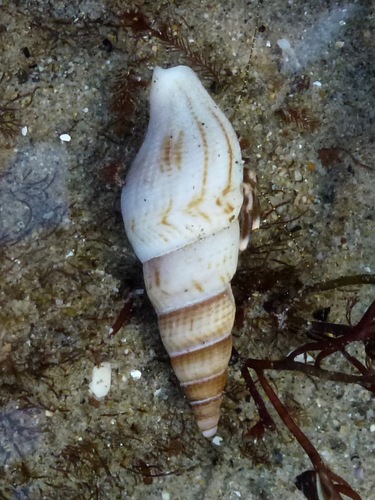
About Ophiodermella inermis (Reeve, 1843)
The shell of Ophiodermella inermis reaches a maximum length of 40 mm and a maximum width of 7 mm. Smaller shells are slender, very acute, and colored livid purple, covered by an olivaceous periostracum, with approximately eleven whorls. Mature shells are pinkish ash-colored beneath a light olivaceous epidermis. Growth lines are sometimes rib-like, oblique, and angulated at the periphery; they are also lighter in color, so the spaces between the lines appear as narrow, angulated stripes of chestnut or reddish color. The entire shell surface is covered with close, revolving incised lines. The protoconch is more or less eroded, but it is apparently smooth, acute, and contains about two and a half whorls. Subsequent whorls are rather flat, compressed, and appressed at and in front of the suture, with a rounded base and an inconspicuous anal fasciole. Sculpture is mostly made up of flattish spiral threads: one thread at the suture, three smaller threads in front of it, followed by a flat broader thread that represents the fasciole, then eight more prominent threads on the body whorl. These prominent threads are undulate or segmented by incremental lines, with wider interspaces that sometimes contain a smaller intercalary thread extending to the base. After these, six or seven unsegmented threads lead to the siphonal fasciole, which itself bears six or seven smaller threads. The sequence of undulations or slightly swollen segments creates a slightly cancellate appearance on the section of the whorl that holds them, but no true axial ribs are present; the effect is instead produced by depressions between the rather coarse incremental lines. The aperture is narrow and acute toward the back. The anal sulcus is narrow and distinct, but not very deep. The outer lip is arcuately produced in front of the anal sulcus. The siphonal canal is contracted, short, and recurved. The inner lip is polished and superficially erased. The columella is twisted, with a thin layer of callus. An operculum is present. This species occurs in the Pacific Ocean, ranging from Alaska to California.

