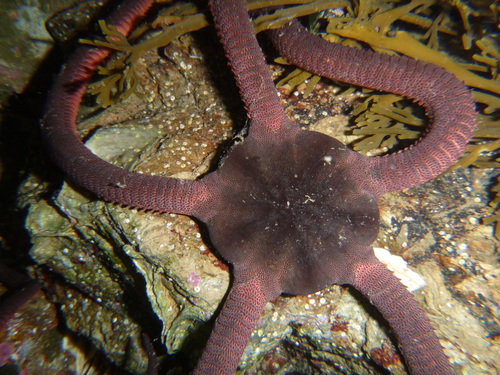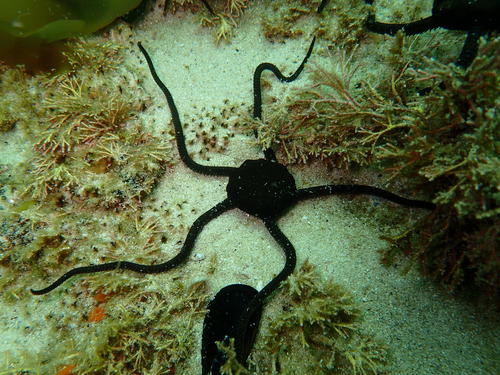
About Ophioderma wahlbergii Müller & Troschel, 1842
Ophioderma wahlbergii Müller & Troschel, 1842 is a species of brittle star that belongs to the genus Ophioderma, which is classified in the family Ophiodermatidae. Research on the related Ophiuroid rubicundum species has documented opportunistic behaviors and an ability to adapt to new environments. Thanks to their high adaptability and strong feeding responses, these brittle stars can thrive in the deep coral reefs of the western Atlantic. Brittle stars can reproduce through three distinct methods: sexual reproduction, asexual reproduction, and larval development. In sexual reproduction, brittle stars use broadcast spawning, where they release eggs and sperm into the water for external fertilization. Fertilized eggs develop into planktonic larvae that drift through the water before settling onto the ocean floor, where they eventually mature into adult brittle stars. Asexual reproduction in brittle stars occurs through regeneration. When an arm is lost, the organism can regenerate a new arm, and in some species, a lost arm can even grow into an entirely new individual. This reproductive method improves survival rates for the species that use it. After fertilization, brittle star larvae go through multiple developmental stages before transitioning into adulthood. In some species, larvae stay attached to their parent until they are able to survive independently. Brittle stars have been observed feeding opportunistically on the spawn of many coral species. During coral spawning events, brittle stars coil their arms around the gamete bundles released by coral to feed.