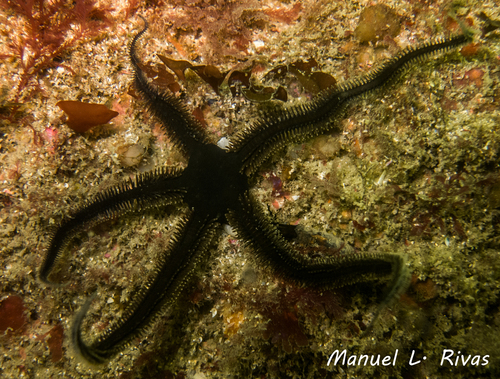
About Ophiocomina nigra (Abildgaard, 1789)
Ophiocomina nigra (Abildgaard, 1789) is a large brittle star with five narrow arms that can reach 125mm in length, and a well-defined central disc that grows up to 25mm wide. Its overall colour is black, or varying shades of brown, though pale-coloured specimens are occasionally found. The upper surface of its disc is covered in fine granules that hide the underlying surface plates. On the underside of the disc, granules are only found on the outer portion, so the plates are visible near the central mouth. The mouth is surrounded by a feeding structure called Aristotle's lantern, which has five toothed jaws, each with an oval jaw plate. A comb-like arrangement of spines runs along both sides of the arms, giving the arms a bristly appearance. On the upper side of each arm segment, a broad plate covers the segment and holds 5 to 7 spines. Tube feet are present on the underside of the arms, but these tube feet do not have suckers.
This species occurs in the eastern Atlantic Ocean from Norway south to the Azores, as well as in the North Sea, the Mediterranean Sea, and the Indian Ocean. It inhabits rocks, boulders, and gravel in the neritic zone down to approximately 100 metres depth, and is occasionally found at greater depths. It is tolerant of low salinity levels.
Ophiocomina nigra is often found living in association with another brittle star, Ophiothrix fragilis. Large numbers of individuals from these two species sometimes form dense communities, with hundreds of brittle stars per square metre. These beds can extend across several hundred square metres of sandy and pebbly sea floor sediment, and hold millions of brittle stars. The communities can be made up entirely of O. nigra, entirely of O. fragilis, or be a mixed population of both species. These large social aggregations help the brittle stars filter feed in fast-moving currents that would otherwise wash them away. Ophiocomina nigra beds typically contain both adult and newly settled juvenile brittle stars, while individuals of intermediate size live in other locations. Other echinoderms commonly found in the same area include predatory starfish Asterias rubens, Luidia ciliaris, and Crossaster papposus, and sea urchins Echinus esculentus and Psammechinus miliaris. Commonly associated crustaceans include crabs Cancer pagurus, Necora puber, and Liocarcinus spp., and the hermit crab Pagurus bernhardus. On rocky outcrops within the dense brittle star aggregations, the soft coral Alcyonium digitatum, hydroid Nemertesia antennina, and sea anemone Metridium senile are often found. Another sea anemone, Urticina felina, may be semi-buried in the sediment within the area, with a surrounding zone that is clear of brittle stars.

