About Ophichthus gomesii (Castelnau, 1855)
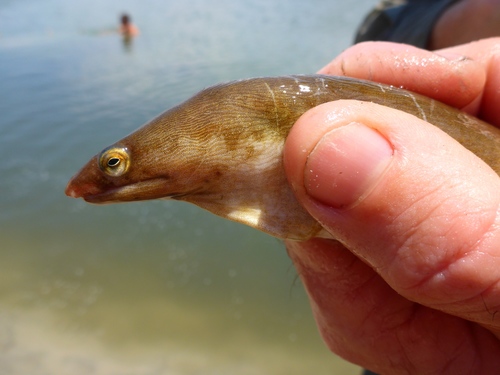
The shrimp eel, scientifically named Ophichthus gomesii (Castelnau, 1855), has an elongated, snake-like body that is typical of eels. Adult individuals have a brown to gray coloration on their dorsal (upper) side, with lighter coloring on their ventral (lower) side. The branchial region, located on the ventral side behind the head, is swollen. Under the skin of this region sits a basket-like structure of overlapping free rays called jugostegalia, which are often visible through the skin. The tail is fleshy, and the species has no caudal fin or pelvic fins. The common total length of an adult shrimp eel is 50 centimeters, and the maximum recorded total length is 91.4 centimeters. This species can be told apart from other eels by its lack of a caudal fin and its external jugostegalia, the basket-like overlapping free ray structure. It can also be distinguished from other snake eels by its lack of body markings, its well-developed pectoral fin, and the origin of its dorsal fin behind the gill slit. Shrimp eels are found in the Western Atlantic Ocean, ranging from Canada to Massachusetts, and from the northern Gulf of Mexico to southern Brazil. They are not present in the Bahamas or most Caribbean islands. They live in gulfs and bays, in waters with sandy or muddy substrates, at depths between 1 and 450 meters.