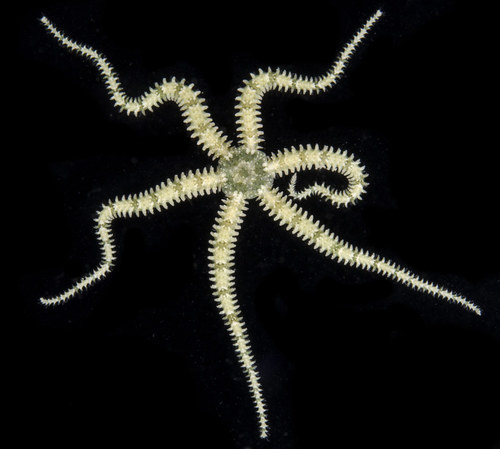
About Ophiactis savignyi (Müller & Troschel, 1842)
The disc of Ophiactis savignyi can reach up to 5 millimetres (0.2 in) in diameter. Its aboral (upper) surface is covered by large overlapping scales and bears scattered spines, particularly around the edges of the disc. Individuals usually have six long, slender, tapering arms, which are made of many segmented sections with joints between each segment. Each arm segment bears five or six thorny spines. The aboral surface of the disc is pale greenish-brown; the large triangular radial shields located close to the arm origins are noticeably darker, creating a contrast. The oral (under) surface is cream-coloured. O. savignyi has a nearly cosmopolitan distribution across warm seas. It is found in the western Indo-Pacific region, the eastern Pacific Ocean, and on both sides of the Atlantic Ocean. Populations in the Pacific and Atlantic Oceans only became connected after the Panama Canal was constructed across the Isthmus of Panama in 1914. This brittle star occurs from the intertidal zone down to a depth of about 500 metres (1,640 ft). It inhabits all reef zones, mangrove habitats, seagrass meadows, areas among seaweeds, and contaminated waters. It is often found living inside sponges, possibly as a commensal. Ophiactis savignyi is both a deposit feeder and a scavenger, feeding on detritus that accumulates on the seabed. It raises the tips of its arms to detect food particles, rolls any nutritious items into a ball, and moves the ball to its mouth, manipulating it using tube feet. Examination of stomach contents found remains of bryozoans, foraminiferans, and gastropods mixed with the large quantities of detritus and sand grains the brittle star had ingested. Individual O. savignyi are either male or female, and can reproduce both sexually and asexually. Sexual reproduction involves releasing sperm and eggs into the sea, after which planktonic larvae develop and eventually settle. Asexual reproduction occurs by fragmentation, and each resulting fragment retains the same sex as its parent. Small, immature individuals (with a disc diameter under 4 millimetres (0.16 in)) usually have six arms and can split themselves in two, then regenerate the missing disc and arm sections, often ending up with five arms. Most larger individuals have five arms and are also capable of fragmentation. Larger males undergo fragmentation more often than larger females, which may explain the observed excess of males in most populations. After splitting, the brittle star may still be able to reproduce sexually, but some disc fragments have no gonads and cannot spawn until regeneration is complete. In Taiwan, mature gametes are present from March to December, but most of the O. savignyi population spawns during May and June. Fission can occur at any time of year, but takes place most often between July and December. Year-round sampling found that 48% of inspected individuals were in the process of regeneration. In this Taiwanese location, the sex ratio is twenty-four males for every one female. In Hawaii, this brittle star is often found living in association with sponges such as Lissodendoryx schmidti (previously classified as Damiriana hawaiiana). Up to twenty individuals can be found clustered together in cavities at the base of the sponge. The area is so filled with slime secreted by the sponge that the brittle stars can barely move their arms. These brittle stars often appear to have broken or partly regenerated arms. It remains unclear how they enter the sponge, how they feed, or how they reproduce in this association.

