About Ophelimus maskelli (Ashmead, 1900)
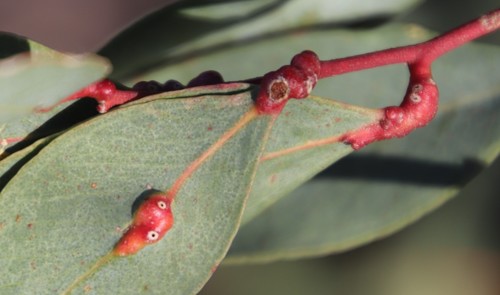
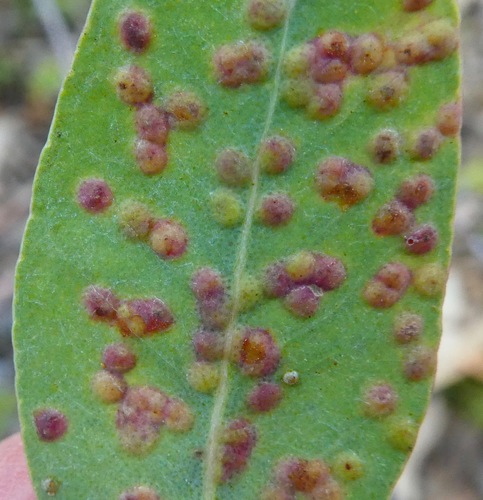
Ophelimus maskelli, commonly called the eucalyptus gall wasp, is a species of chalcid wasp that reaches approximately 1 millimeter in length. It is native to Australia and New Zealand, and has become an invasive species in the Mediterranean, the Middle East, North Africa, South Africa, tropical Asia ranging from Vietnam to Indonesia, and California in the United States. This species is classified as a plant pest: female wasps lay their eggs in immature eucalyptus leaves, and the developing larvae trigger the formation of galls on the leaves. Severe infestations lead to extensive gall formation that causes widespread defoliation of eucalyptus trees and stunted growth. In spring, adult wasps may emerge in very large numbers, forming swarms that are a nuisance to people. In 2006, members of the fairy wasp genus Stethynium were being studied in Australia and Israel as potential biological control agents for Ophelimus maskelli. Releases of three parasitoid species targeting O. maskelli in Israel successfully greatly reduced the wasp's population. Of these three parasitoids, only two — Closterocerus chamaeleon of the family Eulophidae, and Stethynium ophelimi of the family Mymaridae — went on to establish large populations and spread across the Mediterranean Basin, where they have proven to be highly effective biological control agents.