About Operophtera brumata (Linnaeus, 1758)
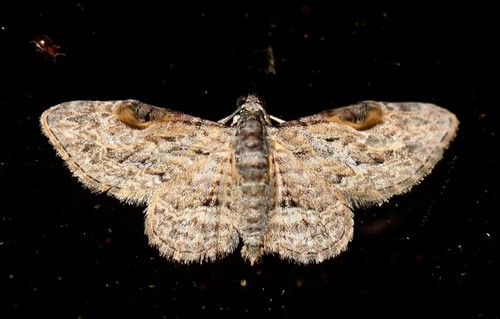
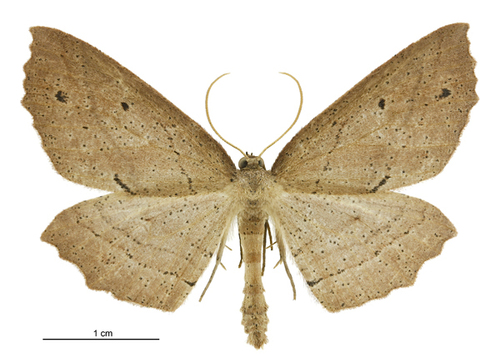
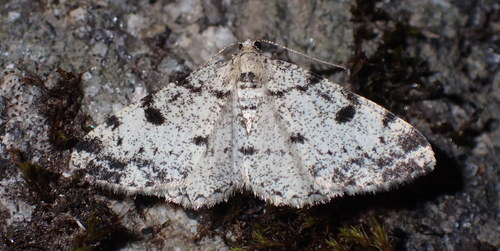
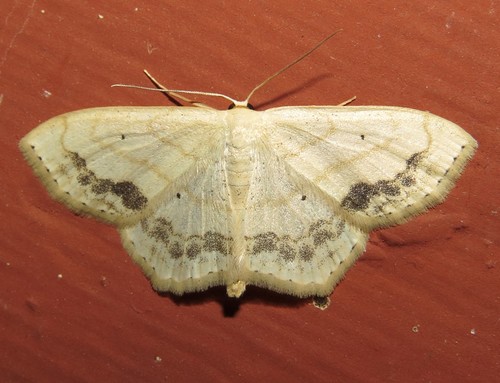
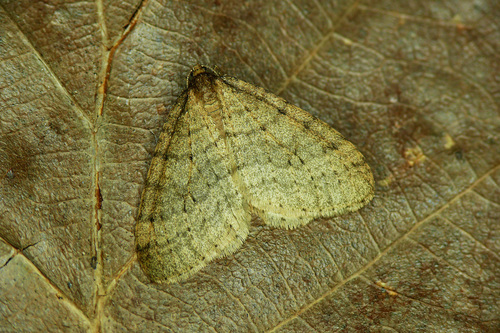
The winged male Operophtera brumata (winter moth) has forewings with a ground colour that ranges from grey-yellow to beige-brown, and is occasionally lightly reddish-tinted. Dark brown band-shaped patterns are common, but they are often indistinct. The forewing fringe is yellowish, and the hindwings are pale grey or yellow grey. Males have short, finely hairy antennae. While female winter moths appear completely wingless at first glance, they actually have greatly reduced, rudimentary wings that form stubs. Flightless females have brownish-grey bodies, and their wing stubs are brown to grey with dark bands. Both sexes have an approximate body length of 1 cm (0.4 in). Newly hatched larvae measure 2.5 mm (0.1 inches) long, and grow to 19 mm (0.75 inches) over six weeks of development. In North America, the winter moth can be mistaken for the related native Bruce spanworm (Operophtera bruceata), and these two species are known to hybridize. This species is native to Northern and Central Europe. To the south, its native range extends to Northern Italy; to the east it reaches the Caucasus and Asia Minor, and to the north it extends to the Baltics. Genetic studies show that European winter moth populations formed through recolonization of the region after the last glacial period. As an invasive species, the winter moth is now found in Nova Scotia, coastal New England (including Massachusetts, Maine, Rhode Island, Connecticut, and New York), and the Pacific northwest, including Vancouver Island. In New England, cold winter temperatures block further inland and northward expansion, so the species is currently limited to coastal Maine and not found further inland. Regionally milder winters linked to global climate change may allow the moth to expand into new areas. A Massachusetts study found that winter moth defoliation reduced the average annual trunk diameter growth rate of oak trees by 47%, and did not cause a significant impact on the growth of maple trees, which experience less defoliation. Winter moth larvae (caterpillars) emerge in early spring from egg masses laid near leaf buds, after a series of days with daytime high temperatures around 10 °C (50 °F). Newly hatched larvae feed on expanding leaf buds, often after burrowing into the bud, then move on to feed on foliage for approximately six weeks. In addition to feeding on the tree where they hatch, young larvae produce silk strands to balloon, meaning they are carried by wind to other trees. By mid-May, the green, roughly one-inch-long larvae descend to the ground. Very little larval mortality from disease has been recorded in North American winter moth populations. Pupation takes place in the soil in late May. Adults emerge from the soil in mid to late November. Although females are flightless, they release a sex pheromone to attract males. After mating, females lay between 150 and 350 tiny eggs in bark crevices, on branches, in lichen, and under bark scales. Due to its long pupal period, the winter moth is vulnerable to many different pupal predators and parasitoids. A study conducted in the Netherlands found that climate warming causes spring temperatures to rise earlier, leading some winter moth eggs to hatch before the tree leaf buds that are the first food source for caterpillars begin to open. Early hatching caterpillars starve, while late hatching caterpillars survive. Because hatch timing is genetically controlled, winter moths are evolving to resynchronize with bud opening by delaying their response to the temperature trigger by 5 to 10 days. Both larvae and adults can withstand below-freezing night temperatures. In New England, density-dependent larval mortality occurs primarily during larval dispersal, and this likely regulates high-density winter moth population dynamics. Larvae prefer oak and apple trees, but also feed on maple, birch, hornbeam, chestnut, hazel, quince, beech, larch, poplar, cherry, pear, rose, raspberry, blueberry, willow, elm, and many other leafy trees and shrubs.