About Oophaga solanensis Posso-Terranova & Andrés, 2018
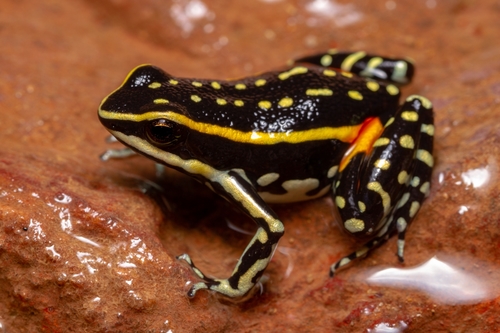
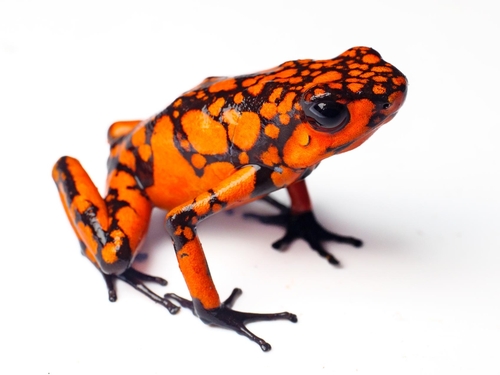
Oophaga solanensis is a large poison dart frog. Its average snout–vent length is 36.2 ± 1.7 mm (1.425 ± 0.067 in), and individual lengths can range from 33 to 55 mm (1.3 to 2.2 in). This species has a dark black base body color, patterned with variable orange or red spots and bracelet-like bands on the limbs. In its most common color pattern, four to five rounded or oval spots are aligned in a line along the center of the back. One or two spots appear on the sides, and an extra spot is sometimes present around the tympanum, or external eardrum. The bracelet-like bands occur on both the upper and lower limbs, and are usually incomplete on the underside of the limbs. The throat and chest have several spots, the tips of the fingers and toes are black, and the skin is smooth. In the northern portion of the species' range, individuals have additional spots on the back outside the central line, as well as larger mottled spots on the underside. This species can be confirmed as a member of the genus Oophaga based on a set of traits: medium to large body size, lack of sexual dimorphism, contrasting bright spots on a solid dark background, absence of the omosternum, relatively large discs on the second, third, and fourth fingers, absence of maxillary and premaxillary teeth, presence of the tarsal tubercle, and alkaloid secretion from the skin. Within the genus, it belongs to the histrionicus-lehmanni-occultator species group, grouped by its medium to large body size, absence of the omosternum, spotted or banded back pattern, and distribution on the Pacific slope of Colombia and northwestern Ecuador. Oophaga solanensis can be distinguished from other similar species in its genus by a combination of size and coloration. O. andresi differs by having a light to dark brown background color, light to dark brown finger and toe tips, and a smaller overall size. O. histrionica also has a light to dark brown background color and light to brown finger and toe tips, and is much smaller than O. solanensis. O. lehmanni has white finger and toe tips, while O. occultator is much smaller. O. anchicayensis is larger, has yellow to pale green coloration and bracelet-like patterns on the back, and does not share a geographic range with O. solanensis. This species is endemic to northwestern Colombia, where it is found across a 16,621 km² (6,417 sq mi) area stretching from the western banks of the Atrato and San Juan rivers to the Pacific coast. The Atrato and San Juan Rivers likely act as a geographic barrier separating O. solanensis from O. andresi. It is widespread across the department of Chocó, with recorded populations near Bajo Baudó, Mecana, Bahía Solano, Serranía del Baudo, La Victoria, El Salero, Nuquí, and Quebrada Docordo. It may range as far south as the western San Juan River, but it is not expected to occur south of the Calima River in Valle del Cauca Department. Like other Oophaga frogs, O. solanensis lives in dense tropical rainforest across its range, at elevations between 0 and 420 m (0 and 1,378 ft). Its habitat has an average temperature of 25.9 °C (78.6 °F) and an average annual precipitation of 6,279 mm (247.2 in). Like all other South American Oophaga, Oophaga solanensis is an aggressively territorial frog. Males defend their territories and attract females by calling from elevated perches such as branches and logs up to 4 m (13 ft) high. Males vocalize throughout the day, with calling activity peaking between 7:00–10:00 and between 13:00–14:30. Their call is described as a "chirp". Females lay eggs within male territories. After the eggs hatch, parent frogs transport tadpoles to phytotelmata (water-filled plant cavities) in bromeliads, and feed the tadpoles with unfertilized eggs. Adult frogs forage for ants and termites on the ground from sunrise until 16:00, after which they hide under ground leaf litter or on logs. They spend nights resting on leaves and tree trunks.