About Onychoprion fuscatus (Linnaeus, 1766)
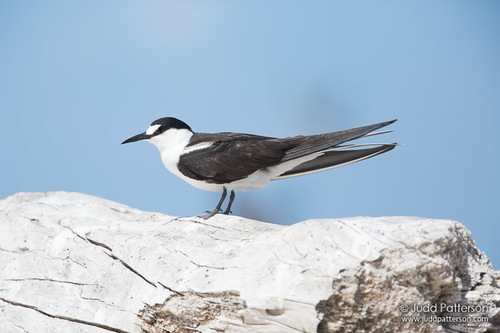
Onychoprion fuscatus, the sooty tern, is a medium-large tern similar in size to the Sandwich tern (Thalasseus sandvicensis), with a body length of 36–45 cm (14–17.5 in) and a wingspan of 82–94 cm (32.5–37 in). It has long wings and a long, moderately deeply forked black tail with white outer edges; the fork is deeper than that of Thalasseus terns, but shallower than the tails of most Sterna terns. Its upperparts are black to dark blackish-brown, its underparts are white, and it has a white forehead, black legs, and a black bill. The average lifespan of this species is 32 years. Juvenile sooty terns are grey-black on both their upper and lower bodies, with narrow pale fringes on upperpart feathers that give the upper body a scaly appearance; only the lower belly is whitish. The sooty tern is unlikely to be confused with other tern species except for the bridled tern (O. anaethetus), which is similarly dark-backed but smaller. Compared to the bridled tern, the sooty tern has a darker back, a broader white forehead, and no pale neck collar. Its call is a loud piercing 'wide-a-wake' (also cited as ker-wack-a-wack), and it also produces a harsh alarm call called kvaark. Sooty terns breed in colonies on rocky or coral islands. They nest in a scrape or hole in the ground and lay a single egg, typically in the afternoon. While reports of two-egg clutches exist, these probably form when an egg from one nest rolls into another. The species feeds by picking fish from the surface in marine environments, often in large flocks. It rarely comes to land except to breed, and can stay out at sea for 3 to 10 years. Because its feathers lack oil, it cannot float and spends this entire time at sea on the wing. This tern is migratory and dispersive, and winters across a wider range of tropical oceans. Compared to most terns, it has very strong marine habits, and is generally found inland only after severe storms. For example, the Field Museum holds a male specimen found exhausted on August 2, 1933 on the slopes of Mount Cameroon above Buea, about 1,000 m (3,300 ft) above sea level, after foul weather hit the Gulf of Guinea. The species is a rare vagrant to western Europe, though one individual stayed at Cemlyn Bay, Wales for 11 days in July 2005. It is also not normally found on the Pacific coasts of the Americas due to its pelagic open-ocean habits. It can be seen more frequently around Baja California, where several nesting locations are offshore, but only two individuals have ever been recorded on the coast of El Salvador: one ring recovered in 1972, and one individual photographed on October 10, 2001 at Lake Olomega that was probably blown there by a storm. Hurricanes can also devastate small breeding colonies; this has been surmised for sooty tern nesting sites on cays off the San Andrés Islands of Colombia. As an exceptionally common bird, the sooty tern is not considered threatened by the IUCN.