About Onoclea sensibilis L.
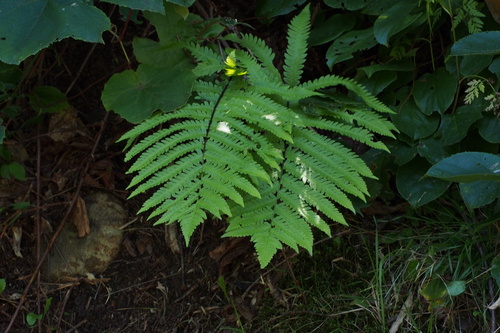
Onoclea sensibilis L., commonly known as bead fern, has sterile and fertile fronds with independent stalks that grow from the same rhizome, a trait that sets it apart from most other ferns. Its bright yellow-green sterile fronds, called trophophylls, are deeply pinnatifid and grow at intervals along a creeping rhizome. These deciduous sterile fronds have swollen bases called trophopods that act as overwinter storage organs. The typical variety, O. var. sensibilis, produces sterile fronds that are 1–1.3 m (3.3–4.3 ft) long, with 5–11 evenly spaced pinnae (leaf pairs) along the stipe. The variety O. var. interrupta Maxim. has shorter sterile fronds, reaching 20–50 cm (7.9–19.7 in) in length, with only 5–8 pairs of pinnae.
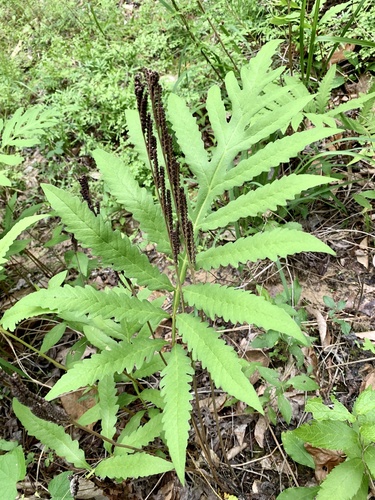
The fertile fronds, called sporophylls, are smaller, measuring 20–45 cm (7.9–17.7 in) long. They are non-green when mature, have very narrow pinnae, and are persistent, remaining standing for 2–3 years. Clusters of sporangia (spore cases) called sori are 2–4 mm (1/10–1/6 in) in diameter, arranged like beads along the upright fertile fronds, which gives the species its common name of bead fern. Sori are typically bilaterally symmetrical, though some plants have pinnae that are fertile only on one side of the rachis. Two forms of this variant, O. sensibilis L. F. hemiphyllodes (Kiss & Kümmerle, 1926) and O. sensibilis L. F. obtusilobata (which has flat pinnules rather than curled, bead-shaped ones), have been deemed non-taxonomic variations that do not merit separate recognition (J. M. Beitel et al. 1981). The unfurling young fiddleheads of this fern are pale reddish in color.
In terms of reproductive morphology, spermatogenesis in this homosporous fern runs from the formation of spermatogenous cells to the release of spores. Unlike what is reported for other fern species, developing spermatids in Onoclea sensibilis are surrounded by two different walls at specific development stages. Other differences from other species include delayed formation of the osmiophilic crest, and the cap cell removes intact during sperm release, instead of forming a pore or collapsing completely. Spores are monolete, and an antheridium (sporangium) contains either 32 or 64 spores, most often 64; regardless of the spore count, the capsule volume remains nearly the same.
Both the timing and mechanics of spore release are controlled by springtime humidity. The small fertile margins that hold spores in tightly rolled structures on living plants keep their dry, leathery shape over winter. When spring brings higher humidity, these pinnules open and release spores into the air. Early in their development, subsequent gametophytes are unisexual, which favors cross-fertilization, and later become bisexual to ensure the species' survival.
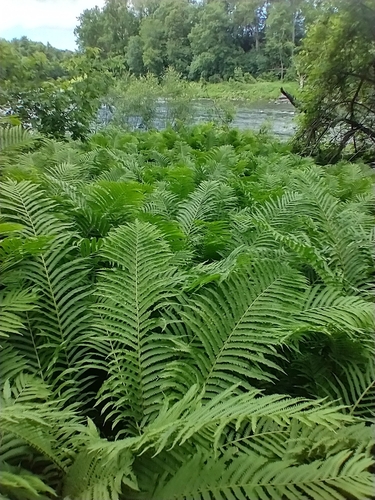
Onoclea sensibilis is native to temperate regions of the Northern Hemisphere, including the Russian Far East, China, and other parts of Eastern Asia, and has a wide native distribution across North America, ranging from Newfoundland south to Florida and west to Texas, the Rocky Mountains, North and South Dakota, Quebec, and Manitoba. It has become naturalized in western Europe and New Zealand. It grows at elevations from sea level up to 1,500 metres (4,900 ft), and only occurs in non-brackish fresh water habitats, since its spore germination stops at salt (NaCl) concentrations of 0.6% or higher. It grows best in moist shaded or partially shaded areas, and can be found in a variety of wetland and woodland habitats including wet meadows, thickets, bogs, stream and riverbanks, and roadside ditches. It tolerates extremely wet soils, growing in soggy ground or at the very edge of water in either shade or sun, and can tolerate drier conditions when grown in shade. It prefers acidic (pH <6.8), loose, sandy to loam, limestone-based soils.
Fossil evidence shows that Onoclea sensibilis has remained essentially unchanged for millions of years; 57-million-year-old Paleocene fossil specimens are virtually identical to modern samples. It has a life cycle with alternation of generations, including both sexual and asexual reproduction: the sporophyte generation matures in autumn, releases spores in spring, and is followed by the gametophyte generation. Sporophytes require 5–10 years of growth before reaching the mature fern height. This fern propagates both by spore dispersal and rhizome growth.
Dense growth clusters of this fern provide habitat for local small wildlife; deer bed on its dense mats, and wild turkeys use the fertile spore stalks as a secondary food source in winter. It can become aggressive and a nuisance when it grows near desirable vegetation, and is classified as a herbaceous broadleaf weed in the University of Maine Cooperative Extension guide for Maine wild blueberries. While its deciduous fronds cannot tolerate freezing temperatures, the plant survives in USDA hardiness zones 4–8, corresponding to minimum temperatures of −20 to −15 °C (−4 to 5 °F), holding the Royal Horticultural Society's H6 hardiness rating. Winter survival improves when dried frond petiole bases are left intact. Onoclea sensibilis may form beneficial nutrient-exchanging ectotrophic mycorrhizal associations when growing in oak and hickory forests, alongside Pteridium aquilinum and Adiantum pedatum. Because of its observed affinity for wetter soils, it is a wetland indicator, listed as a Facultative Wetland Hydrophyte on the 2013 U.S. National Wetland Plant List.
Opinion is mixed on this species' tolerance to disturbance of its growing environment. In one forest site, a decade-long population decline was observed after even a single tree felling operation. In other sites, it acts as an opportunistic species that is not harmed by disturbance. It spreads to form colonies, and is often one of the first species to colonize disturbed areas.
Onoclea sensibilis has limited food use, and is considered a famine food by some, reserved for times of scarcity. Cooking eliminates its thiaminase content. The Iroquois used it as an early spring vegetable, preparing the fiddleheads like spinach by cooking them and seasoning with salt, pepper, or butter (Waugh, 1916). Leaves were processed the same way after removing the brown scales (sori). Its young shoots have been sold as delicacies in Asian markets. Historically, Native American peoples used Onoclea sensibilis in both oral and topical indigenous folk medicine treatments.