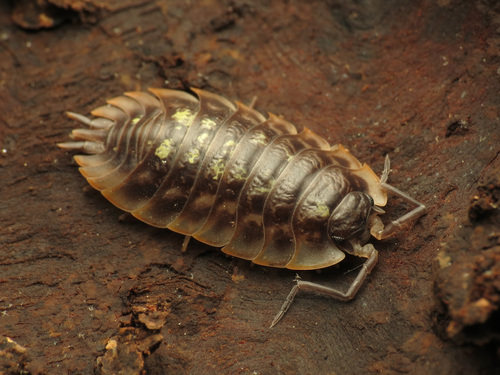
About Oniscus asellus Linnaeus, 1758
All members of the genus Oniscus are defined by several shared morphological characteristics. Oniscus species have three-segmented flagella, a wide abdomen, and a head with lateral lobes. They cannot roll themselves completely up into a ball. Harriet Richardson described the body of Oniscus asellus as being roughly one and a half times longer than it is wide, measuring approximately 10 mm wide by 16 mm long (390 by 630 mils). Its head is longer than it is wide, at 2 mm wide by 3 mm long (79 by 118 mils), with a slightly convex front margin. Pronounced, narrow, elongate anterolateral lobes are present; these are nearly 1 mm (39 mils) long and have rounded anterior ends. The small compound eyes are located on the sides of the head, at the base of these prominent lobes. There are two pairs of antennae: the first pair is inconspicuous and only has a couple of segments, while the second pair is made of five segments, each longer than the previous one. All thoracic segments are nearly equal in length. The first thoracic segment has projections that extend to surround the head, and all thoracic segments expand out to the sides, with straight lateral margins. The abdominal segments are distinct; the first two abdominal segments are somewhat shorter, and their lateral portions are covered by the overhanging seventh thoracic segment. Abdominal segments three through five have extensions that continue the oval outline of the body. The lateral extensions of the fifth abdominal segment extend far backward, reaching as far as the end of the sixth and final abdominal segment. This final segment is triangular in shape, with its apex formed by a posteriorly pointed process. The uropoda are mostly covered by this final abdominal segment. The common woodlouse (Oniscus asellus) is the most widespread woodlouse species in the British Isles, both geographically and ecologically, and is counted among Britain's most pervasive wildlife. It is equally well adapted to northern and southern areas, and has been recorded in every vice-county of England, Scotland, Wales, and Ireland. It is less common in the Mediterranean Basin, but widespread across Northern and Western Europe, ranging from Portugal to Sweden and extending as far east as Ukraine. It is also present in the Azores and Madeira, and has been widely introduced to the Americas, predominantly in Mexico and the United States, where it occurs east of the Mississippi River and west of the Rocky Mountains. According to the British Myriapod and Isopod Group, Oniscus asellus, along with Porcellio scaber, represents the archetypal 'woodlouse' that is familiar to the general public. As of April 2025, Oniscus asellus is the third-most observed woodlouse species in the world on the citizen science website iNaturalist, ranking below Porcellio scaber and Armadillidium vulgare. The common woodlouse occurs in a wide range of habitats, including habitats with little available calcium, but does not live in dry habitats. It can be found both inland and in coastal areas, and is chiefly found in the countryside. It is also a successful synanthrope, and is a frequent inhabitant of human spaces such as greenhouses, gardens, and parks. It occurs on waste ground, in open woodlands, forests, gardens, grasslands, and scrub, and around buildings. In one study of existing records, 22% of O. asellus records (a plurality) came from road verges, though the species has also been collected from cliff faces and quarries. It most commonly lives in moist environments under rocks or dead wood, but has also been recorded in leaf litter, human constructions, and garbage. It is especially prevalent in rotting wood, a preference that allows it to live in areas otherwise unsuitable for woodlice, such as moorlands. When he described the species in 1758, Linnaeus noted it was found in houses, as well as rotting wood, hibernacula, and walls. Toads and newts may predate on woodlice including this species. According to Stefan Gates, their meat is sweet, has a taste similar to crab or shrimp, and carries considerable umami flavour.

