About Ondatra zibethicus (Linnaeus, 1766)
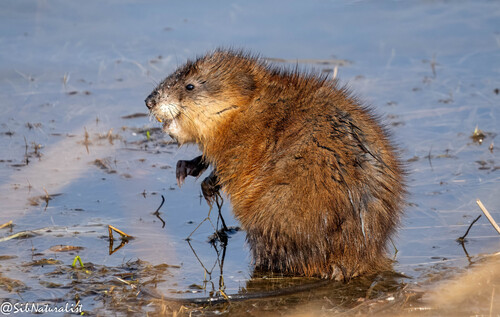
An adult Ondatra zibethicus, commonly known as the muskrat, measures 40–70 cm (16–28 in) in total length, with half of this length made up by the tail, and weighs 0.6–2 kg (1+1⁄4–4+1⁄2 lb). This weight is around four times that of the brown rat (Rattus norvegicus), even though an adult muskrat is only slightly longer than a brown rat. It is almost certainly the largest and heaviest member of the diverse family Cricetidae, which includes all voles, lemmings, and most mice native to the Americas, as well as Eurasian hamsters. Muskrats are much smaller than beavers (Castor canadensis), and the two species often share the same habitat. Muskrats have short, thick fur that ranges from medium to dark brown or black, with a lighter-colored belly, a pattern called countershading; as the animal ages, part of its fur turns gray. Their fur has two layers that help protect them from cold water. They have long tails covered with scales instead of hair. To help them swim, their tails are slightly flattened vertically, a shape that is unique to muskrats. When muskrats walk on land, their tails drag along the ground, which makes their tracks easy to identify. Muskrats spend most of their time in water, and are well adapted to their semiaquatic lifestyle. They can swim underwater for 12 to 17 minutes. Like the bodies of seals and whales, muskrat bodies are less sensitive to carbon dioxide buildup than the bodies of most other mammals. They can close their ears to keep water out. Their hind feet are partially webbed, and act as their primary source of propulsion when swimming. Their tail works as a rudder to control their swimming direction. Musk glands are located inside the tail. Muskrats are native to most of Canada, the United States, and a small area of northern Mexico. They were introduced to Europe at the start of the 20th century, and have become an invasive species in northwestern Europe. They live primarily in wetlands, including areas in or near saline and freshwater wetlands, rivers, lakes, and ponds. They are not found in Florida, where the round-tailed muskrat, also called the Florida water rat (Neofiber alleni), occupies their ecological niche. Muskrat populations follow natural cycles; in areas where they become very abundant, they can remove most of the vegetation in wetlands. They are thought to play a major role in shaping the vegetation of prairie wetlands in particular. They also selectively remove plant species they prefer, which changes the abundance of plant species across many types of wetlands. Cattail and yellow water lily are common plant species eaten by muskrats. Alligators are thought to be an important natural predator of muskrats, and the absence of muskrats from Florida may be partially caused by alligator predation. While a large amount of wetland habitat has been lost to human activity, the construction of canals and irrigation channels, such as acequias, has created new habitat for muskrats, and the species remains widespread. Muskrats can live alongside streams that hold sulfurous water that drains from coal mines. Fish and frogs die in these streams, but muskrats can still thrive and occupy the associated wetlands. Muskrats also benefit when humans persecute some of their predators. The muskrat is classified as a "prohibited new organism" under New Zealand's Hazardous Substances and New Organisms Act 1996, which bans importing the species into the country. Muskrats can also be infected by the trematode Metorchis conjunctus. Muskrats have sometimes been used as a food source by North Americans and other groups. Since the 19th century, some Catholics in southeastern Michigan have occasionally eaten muskrats, for example on days when consumption of other meats is prohibited. Preparation typically requires removing the musk glands located in the tail, which can otherwise contaminate the lower belly of the animal. Muskrat fur is warm, and reaches prime quality in northern North America at the start of December. In the early 20th century, trapping muskrats for their fur became an important industry in the region. During this period, the fur was specially trimmed and dyed to be widely sold across the United States under the name "Hudson seal" fur. Muskrats were introduced to Europe at this time as a fur resource, and later spread across northern Europe and Asia. The winter hats worn by the Royal Canadian Mounted Police are made from muskrat fur.