About Oncosiphon suffruticosus (L.) Källersjö
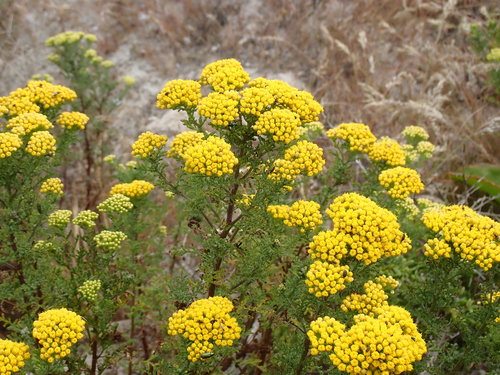
Commonly called shrubby mayweed, Oncosiphon suffruticosus (L.) Källersjö is an annual plant. It flowers from September to December, growing in barren sandy soils such as salt marsh shores. It reaches roughly 50 cm (knee-high) in height, with feathery gray-green pinnatisect, glabrous leaves that carry an irritating smell. Its flowers are bisexual, forming many small yellow button-shaped heads around 5 mm (0.20 in) in diameter that are made up entirely of disc florets. These flower heads are arranged in a corymb inflorescence that can grow up to 30 cm wide. It produces brown fruits topped with white tufts of hairs that aid wind dispersal. Seeds are dispersed by wind between October and January. Unlike fruits of its close relatives Foveolina and Pentzia, the fruits of this species do not have myxogenic cells, so they cannot absorb and store water for germination when exposed to water. Historically, this plant has been used in traditional herbal medicine by the Khoi-San and Cape Dutch communities for a range of ailments. It is used as a tonic for general health, and also as a digestive, anthelmintic, and diuretic. It is also used to treat specific conditions including infantile convulsions, stomach pain, typhoid fever, rheumatic fever, and influenza. Leaf juice mixed with breastmilk is used to treat cramps and gas in infants, and the plant can be prepared as a poultice to treat scorpion stings. More recently, research has been conducted on the essential oil of Oncosiphon suffruticosus. Study findings indicate that this essential oil has potential as a cosmetic ingredient, specifically offering sun protection (SPF), which makes it a potential candidate for use in sunscreen. These results are new and have only been tested in vitro, so more research is needed before this use can be put into practice.