About Oncorhynchus tshawytscha (Walbaum, 1792)
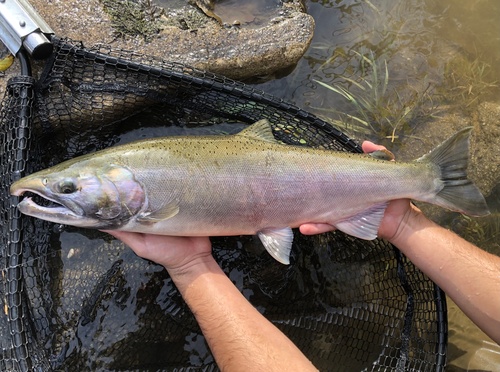
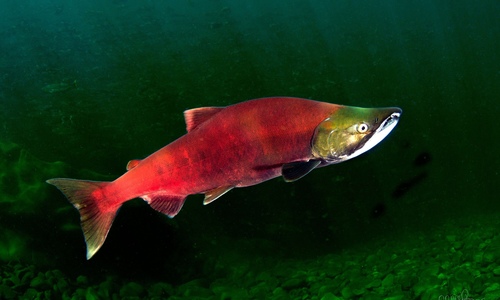
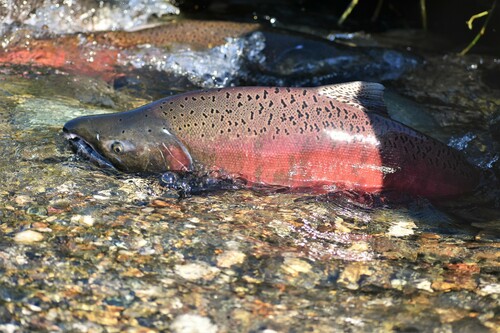
Chinook salmon (Oncorhynchus tshawytscha (Walbaum, 1792)) is the largest species of Pacific salmon. Its back and the top of its head are blue-green, red, or purple, with silvery sides and white ventral surfaces. It has black spots on its tail and the upper half of its body. Among Pacific salmon, Chinook are unique in having both black spots and silver coloration on the tail, unlike pink salmon which only have spots and coho and chum salmon which only have silver on the tail. Another unique feature of Chinook salmon is a black gum line that is present in both salt and fresh water. Adult Chinook salmon typically range from 60 to 90 cm (24 to 36 in) in length, and may reach up to 150 cm (58 in). Their average weight is 4.5 to 22.7 kg (10 to 50 lb), and they can reach up to 59 kg (130 lb). Mature Chinook in Alaska's Kenai River average 16.8 kg (37 lb 1 oz). The current sport-caught world record Chinook, weighing 44.1 kg (97+1⁄4 lb), was caught on May 17, 1985, in the Kenai River. The commercial catch world record is a 57 kg (126 lb) individual caught near Rivers Inlet, British Columbia, in the late 1970s. Chinook salmon meat can be either pink or white, depending on the salmon's diet.
Historically, the native natural range of Chinook salmon in North America extends from the Ventura River in California in the south to Kotzebue Sound in Alaska in the north. Recent studies confirm Chinook salmon are also historically native to California's Guadalupe River watershed, the southernmost major metropolitan area with salmon runs in the United States. However, Chinook populations have disappeared from large areas where they once thrived, or declined by as much as 40 percent. In many regions, their inland range has been reduced, primarily by dams and habitat alterations; this includes Southern California, some areas east of the Coast Ranges of California and Oregon, and large areas in the Snake River and upper Columbia River drainage basins. In areas such as California's Sacramento–San Joaquin River Delta, survival of juvenile Chinook salmon is extremely low, with less than 1% surviving to maturity. In the western Pacific, Chinook salmon range from northern Japan (Hokkaido) in the south to the Arctic Ocean, reaching as far north as the East Siberian Sea and the Palyavaam River. They are consistently present and their distribution is well documented only in Kamchatka. Information about them is scarce elsewhere: they have a patchy distribution in the Anadyr River basin and parts of the Chukchi Peninsula, and stocks may persist in parts of northern Magadan Oblast near Shelikhov Gulf and Penzhina Bay but remain poorly studied.
Like many other salmon species, Chinook salmon are euryhaline, meaning they live in both saltwater and freshwater environments over their lifetime. After hatching, Chinook spend one to eight years in the ocean (averaging three to four years) before returning to their home rivers to spawn. As they prepare to spawn, they undergo major morphological changes: they lose the silvery blue coloration they had as ocean fish, their color darkens, and sometimes they develop a drastically different hue. Chinook are sexually dimorphic: males develop canine-like teeth, and their jaws grow a distinct curved hook called a kype. Research shows larger, more dominant male Chinook have a reproductive advantage, as female Chinook are often more aggressive toward smaller males. Chinook spawn in larger and deeper waters than other salmon species, and can be found on spawning nests (called redds) from September to December. A female may lay her eggs in four to five separate nesting pockets within a single redd. After laying eggs, females guard the redd for four to 25 days before dying, while males leave to seek out additional mates. Chinook eggs hatch 90 to 150 days after being deposited, with hatching time depending on water temperature. Egg deposition is timed so that young salmon fry emerge during a season suitable for survival and growth. Fry and parr (young Chinook) usually stay in fresh water for 12 to 18 months before traveling downstream to estuaries, where they remain as smolts for several months. Some Chinook return to fresh water to spawn one or two years earlier than other individuals of the species; these are called "jack" salmon, and they are typically less than 60 cm (24 in) long but already sexually mature.
The Yukon River hosts the longest freshwater migration route of any salmon; Chinook travel over 3,000 km (1,900 mi) from the river's mouth in the Bering Sea to spawning grounds upstream of Whitehorse, Yukon. Since Chinook rely on fat reserves for energy after re-entering fresh water, commercially caught Chinook from this area are highly valued for their unusually high levels of heart-healthy omega-3 fatty acids, though high harvest and transport costs in this rural region make them less affordable. The highest elevation where Chinook spawn is in the Middle Fork and Upper Salmon River in Idaho; these fish travel over 2,100 m (7,000 ft) in elevation and over 1,400 km (900 mi) on their migration, passing through eight dams and reservoirs on the Columbia and Lower Snake Rivers.
Young Chinook eat amphipods, other crustaceans, and insects, while older Chinook primarily eat other fish. Young salmon feed in streambeds for a short period until they are strong enough to travel out to the ocean to feed. Chinook juveniles are divided into two types: ocean-type and stream-type. Ocean-type Chinook migrate to salt water in their first year, while stream-type salmon spend one full year in fresh water before migrating to the ocean. After a few years growing in the ocean, adult Chinook are large enough to escape most predators, and return to their natal streambeds to mate. Some Chinook have extended lifespans, spending one to five years in the ocean and reaching eight years of age total; more northerly populations tend to have longer lives.
Chinook salmon require suitable spawning habitat: clean, cool, oxygenated, sediment-free fresh water is essential for egg development. Chinook use larger gravel sediment for spawning than other Pacific salmon. Riparian vegetation and woody debris help juvenile salmon by providing cover and keeping water temperatures low. Chinook also require healthy ocean habitats. Juvenile salmon grow in clean, productive estuarine environments to build up energy for migration, before undergoing physiological changes to adapt to life in salt water. As they travel to the open ocean, they rely on eelgrass and seaweeds for camouflage from predators, shelter, and foraging habitat. Adult Chinook need a rich, open ocean habitat to gain the strength required to travel back upstream, escape predators, and reproduce before dying. As David Montgomery writes in his book King of Fish: "The reserves of fish at sea are important to restocking rivers disturbed by natural catastrophes." Because of this, it is critically important that the fish can reach the oceans to grow into healthy adult fish to sustain the species, without being blocked by man-made structures such as dams.
Algae levels are an indicator of high productivity and growth rates in ocean habitats that support salmon. Higher algal levels lead to higher levels of carbon dioxide in the water, which transfers into living organisms and supports the growth of underwater plants and small organisms that salmon eat. Algae can also filter high levels of toxins and pollutants from water. Because of this, it is essential that algae and other water-filtering organisms are not destroyed in the oceans, as they support the health of the food chain that Chinook depend on.
Some Chinook salmon populations are endangered, so precautions are needed to prevent overfishing and habitat destruction, including appropriate management of hydroelectric and irrigation projects. If too few fish remain due to unsustainable fishing and land management practices, salmon struggle to reproduce, and affected stocks can decline. According to one Seattle Times article, "Pacific salmon have disappeared from 40 percent of their historic range outside Alaska," and it concludes that people must understand the habitat needs of salmon and avoid contributing to destructive practices that harm salmon runs. In the Pacific Northwest, large summer-run Chinook that were once common before dams and overfishing caused population declines are known as June hogs.
A Chinook salmon's birthplace and early development can be tracked by examining its otolith, or ear bone. This bone records the chemical composition of the water the fish has lived in, similar to how a tree's growth rings record information about dry and wet years. The otolith builds up the chemical signature of the environment that hosted the fish, allowing researchers to determine where different individual Chinook were born and lived during their first year of life. Testing is done by measuring strontium in the bone; strontium allows researchers to accurately identify the exact location and timing of a fish's time swimming in a river.