About Oncorhynchus nerka (Walbaum, 1792)
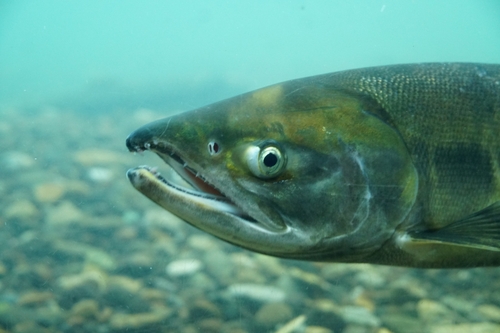
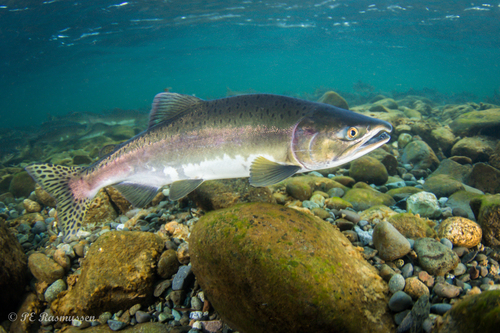
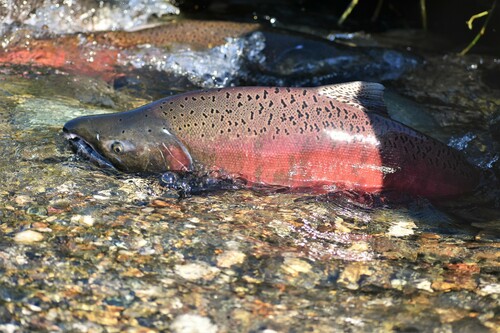
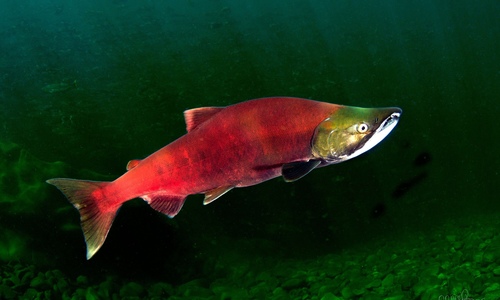
Sockeye salmon, whose scientific name is Oncorhynchus nerka (Walbaum, 1792), are sometimes called red salmon or blueback salmon because of their coloration. While living in the ocean, sockeye salmon have blue bodies with silver tints. When they return to their spawning grounds, their bodies turn completely red and their heads turn green. Adults range from 60 to 84 cm (2 feet 0 inches to 2 feet 9 inches) in length, and weigh between 2.3 and 7 kg (5 to 15 pounds). They have two key distinguishing features: long, serrated gill rakers that number between 30 and 40, and a complete lack of spots on their tail or back. In the Pacific Ocean, sockeye salmon range as far south as the Columbia River in the eastern Pacific; individual sockeye have also been spotted as far south as the 10 Mile River on California's Mendocino Coast. In the western Pacific, their southern range extends to northern Hokkaido, Japan. To the north, their range reaches Bathurst Inlet in the Canadian Arctic in the east, and the Anadyr River in Siberia in the west. The farthest inland that sockeye salmon travel is to Redfish Lake, Idaho, which is over 1,400 km (900 mi) upriver from the ocean and sits at an elevation of 2,000 m (6,500 ft). Populations of sockeye salmon have been completely extirpated from Idaho and Oregon in the United States. Sockeye salmon have a variety of different life history patterns. The majority of sockeye are anadromous: juvenile salmon migrate from freshwater lakes and streams to the ocean, then return as adults to their natal freshwater habitat to spawn. Like most Pacific salmon, sockeye salmon are semelparous, which means they die after spawning once. Some sockeye salmon, called kokanee, do not migrate to the ocean at all and spend their entire lives in freshwater lakes. Most sockeye spawn in rivers near lakes, and juveniles spend one to two years in the nearby lake before migrating to the ocean, though some populations move to saltwater in their first year. Adult sockeye spend two to three years in the ocean before returning to freshwater to spawn. Females spawn in 3 to 5 different nests (called redds) over the course of several days. Eggs usually hatch between six and nine weeks after being laid, and the newly hatched fry typically rear in lakes before migrating out to the ocean. During the breeding season, males use both competitive and sneaking mating tactics, and form either hierarchical social structures or non-hierarchical groupings around receptive females. Variation in reproductive success is larger for males than it is for females. This greater variability in male reproductive success is linked to the larger average body size and exaggerated body shape of mature males. For females, reproductive success depends on the number of eggs they lay, their body size, and the survival rate of the eggs, which is partially determined by the quality of the nest environment. The spatial distribution of males changes based on shifts in reproductive opportunities, the physical traits of the breeding site, and the operational sex ratio (OSR) of the local habitat. Non-dominant males display subordinate behavior, acting as satellites to already mated pairs. During spawning, a subordinate male will quickly move into the female's redd and release his sperm. Dominant males from other nearby redds will also do this. A male's social status is positively correlated with his body length and the size of his dorsal hump. Larger females tend to spawn in shallower water, which they prefer over deeper water. Mature sockeye salmon have dramatic sexual dimorphism. Males undergo many morphological changes when they mature: their body depth increases, their hump height increases, and their snout length increases. Females also experience an increase in snout size, but they do not see an increase in hump height or adipose fin length. This pattern suggests that longer snout sizes are sexually selected, but hump height and adipose fin length are not. Mature females develop large gonads that make up roughly 25% of their total body mass. Females are responsible for all parental care. They select, prepare, and defend their nest site until they die or are displaced by another fish. Males do not participate in parental care at all, and they move between different females after eggs have been deposited.