About Oncorhynchus kisutch (Walbaum, 1792)
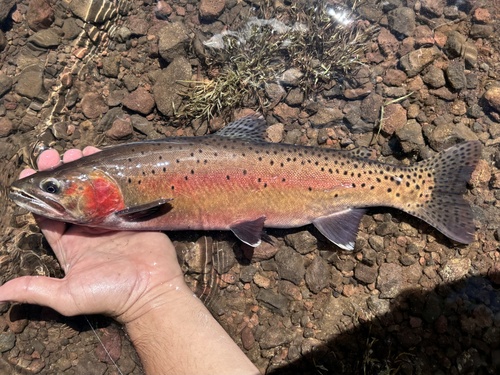
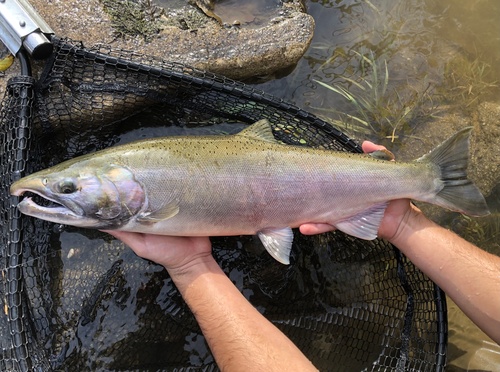
Description: During their ocean phase, coho salmon (Oncorhynchus kisutch) have silver sides and dark-blue backs, with spots covering their back and upper tail lobe. When they enter their spawning phase, their jaws and teeth become hooked. After moving into fresh water, they develop bright-red sides, bluish-green heads and backs, dark bellies, and dark spots on their backs. Sexually maturing fish develop a light-pink or rose shading along the belly, and males may show a slight arching of the back. Mature adults have a pronounced red skin color with darker backs and spots; females have darker shades than males. Mature adults also develop a large hooked beak called a kype, which is used to attract a mate during spawning; males have a more pronounced kype than females. The lower jaw of coho salmon can be identified by a light shade along its upper edge. On average, coho salmon measure 20 to 28 inches (50.8 to 71 cm) long and weigh 7 to 11 pounds (3.2 to 5.0 kg), and they occasionally reach up to 36 pounds (16 kg). Size varies depending on the fish's age and geographic location, and males tend to be slightly larger than females.
Range: The traditional range of coho salmon extends along both sides of the North Pacific Ocean, from Hokkaidō, Japan and eastern Russia, around the Bering Sea to mainland Alaska, and south to Monterey Bay, California. Coho salmon have also been introduced to all of the Great Lakes, as well as many landlocked reservoirs throughout the United States. Coho salmon were first introduced to Lake Erie in the 1920s to control the lake's alewife population. Large-scale stocking began in 1966, when 660,000 fingerlings were introduced to Lake Michigan. Wisconsin started an annual introduction program that stocked 500,000 fry per year, mainly along the coastline of Lake Michigan. By 1970, the species was present in all of the Great Lakes. Ontario and Minnesota started stocking programs in 1969, but later abandoned them. Colorado began stocking coho salmon in the early 1900s, and only limited reproduction has been recorded in the Colorado River. Another stocking effort was carried out in New Hampshire in the late 1960s; the introduced fish dispersed to Maine and Massachusetts, and sporadic reproduction has been recorded there. Natural reproduction is generally low in areas where coho salmon have been introduced. Limited self-sustaining populations have been recorded in Lake Superior and Lake Michigan, but the species does not reproduce naturally in the Wisconsin tributaries of Lake Michigan and relies on stocking to maintain a large population. The species is no longer stocked in Lake Erie, though stray individuals from other parts of the Great Lakes are occasionally caught there. Efforts to establish the species in Connecticut began in the 1800s, but were discontinued after the species failed to establish a stable population. Introduction attempts in Connecticut and Delaware also failed to establish permanent populations. Over twenty specimens were caught in waters surrounding Denmark and Norway in 2017. Their source is currently unknown, but the species is farmed at several locations in Europe, making it likely that these individuals escaped from a fish farm.
Reproduction: Once mature coho salmon reach three or four years old, they swim up freshwater rivers and streams to spawn. Coho salmon travel upstream as far as they are physically able, usually reaching areas of water as shallow as 5 centimetres (2.0 in). Females seek out gravel beds at the head of a riffle, where they turn on their sides to dig a nest by moving their tail, creating round or oval depressions roughly the same length and width as the fish. They repeat this process to create up to seven nests, each of which is called a redd. Females become extremely aggressive toward each other competing for nesting sites, and toward males until the nests are dug. Males then fight for the right to mate. Once a female has chosen a mate, almost always the largest male, she lays her eggs onto the redd, while he releases milt (sperm) onto the eggs at the same time. Unchosen males also sneak in to release milt during this process. After all eggs are laid, the female covers them with rocks and pebbles using her tail. The adult coho salmon then undergo semelparity: they stop eating, deteriorate, and die.
Ecology: During their freshwater life stages, coho salmon feed on plankton and aquatic invertebrates in the benthos and water column, including chironomids, midge larvae, and terrestrial insects that fall into the water. When they enter the marine environment, they switch to a diet of plankton and fish; fish make up most of their diet once they reach a certain size. Introduced coho populations in the Great Lakes feed primarily on alewife and smelt. Great Lakes coho salmon are known to compete with native lake trout, brook trout, and brown trout for food and space when resources are scarce. Because coho salmon emerge earlier and hatch at a larger size, they typically have an advantage in these competitive interactions. Salmonid species on the west coast of the United States have experienced dramatic declines in abundance over the past several decades, caused by a combination of human-induced and natural factors.