About Oncorhynchus keta (Walbaum, 1792)
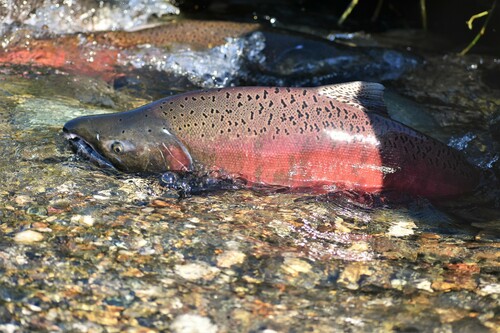
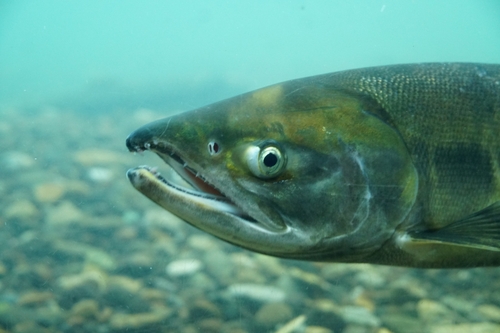
Chum salmon (Oncorhynchus keta) have a deeper body than most other salmonid species. Like other Pacific salmon species, their anal fin has 12 to 20 rays, while European salmonid species have a maximum of 12 anal fin rays. When living in the ocean, chum salmon have silvery blue-green coloration with faint darker spots and a noticeably paler belly. Their color changes to dark olive green when they move into fresh water, and their belly also darkens. As adults near spawning, they develop purple blotchy streaks near the caudal peduncle that grow darker toward the tail. Spawning males typically develop an elongated snout called a kype, white tips on their lower fins, and enlarged teeth; some researchers hypothesize these traits help males compete for mates. Chum salmon have the largest natural range of any Pacific salmon. They are found throughout the North Pacific, off the coasts of Japan, Korea, the Russian Far East, British Columbia (Canada), and from Alaska to California (United States). They make the longest migrations of any species in the genus Oncorhynchus, traveling far up the Yukon River in Alaska and Canada, and deep into the Amur River basin in Northeast China and Russia. Smaller numbers travel thousands of kilometers up the Mackenzie River. In the Arctic Ocean, small populations are found from the Laptev Sea to the Beaufort Sea. In North America, chum salmon spawn from the Arctic's Mackenzie River south to Oregon's Umpqua River. They have also been recorded in the San Lorenzo River near Santa Cruz, California in 1915, and in the Sacramento River in northern California in the 1950s. In fall 2017, six chum salmon were counted in Lagunitas Creek, about 25 miles (40 km) north of San Francisco, California. In the open ocean, chum salmon remain mostly in the upper part of the water column, and rarely dive deeper than 50 m (160 ft). They typically swim at an average depth of 13 m (43 ft) below the surface during the day, and 5 m (16 ft) below the surface during the night. Chum salmon live an average of three to five years, and chum salmon in Alaska mature at five years of age. The total recorded commercial harvest of chum salmon in the North Pacific in 2010 was approximately 313,000 tons, equal to 91 million individual fish. Half of this 2010 catch came from Japan, with roughly a quarter each from Russia and the United States. By weight, the 2010 chum salmon harvest made up about 34% of the total harvest of all Pacific salmon species combined. Chum salmon is the least commercially valuable salmon in North America. Though they are very abundant in Alaska, commercial and recreational fishers often do not target them because of their low market value, as they are considered the least desirable salmon for human consumption. Recent market developments have increased demand for chum salmon, following the creation of new markets in Japan and Northern Europe between 1984 and 1994. Chum salmon have long been a traditional source of dried salmon.