About Oncorhynchus henshawi (Gill & Jordan, 1878)
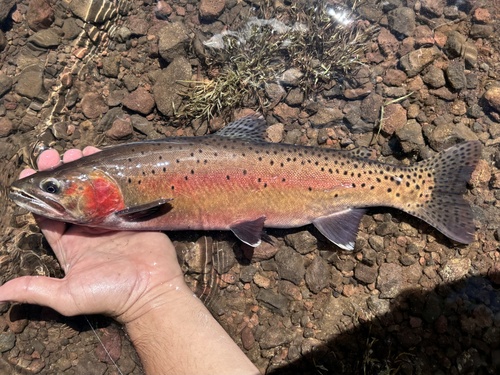
Oncorhynchus henshawi, commonly called Lahontan cutthroat trout, is a distinct and diverse species, shaped by a long history of isolation and evolution. Key distinguishing characteristics include medium-sized, roundish spots spread across the body, head, and often the abdomen; the highest count of gill rakers among all cutthroat trout, ranging from 21 to 28 and averaging 23 to 26; and an abundance of pyloric caeca, numbering 40 to 75, with most individuals having more than 50. Typical vertebral counts fall between 61 and 63, while lateral line scales range from 150 to 180. The species is known for its ability to grow to very large sizes: a recorded specimen weighed 18.6 kg, and there are reports of a 28 kg individual caught from Pyramid Lake. Lahontan cutthroat trout and its subspecies share a 64-chromosome karyotype, and genetic features such as diagnostic allozyme loci and SNPs also define the species. Phenotypically, the species has two main forms: a large lacustrine form adapted to lake habitats and a smaller fluvial form adapted to river habitats. Lahontan cutthroat trout are concentrated in the Lahontan hydrographic basin. This basin covers most of northern Nevada, and extends into northeastern California and southeastern Oregon. Within the basin, the species occurs across several key regions that are sometimes categorized as unique evolutionary units or geographic management units. These regions include the western Lahontan Basin, which holds the Truckee, Carson, and Walker River basins, plus major lake systems that are remnants of ancient Lake Lahontan, such as Pyramid Lake and Walker Lake, as well as the Summit Lake drainage. The species' range also covers the eastern Lahontan Basin, which includes the Humboldt and Reese River basins, and the northwestern Lahontan Basin, which includes the Quinn River, Coyote Lake, and Summit Lake basins. Specifically, Willow and Whitehorse Creeks in the Coyote Lake basin are the only historic habitat for Lahontan cutthroat trout in this portion of southeastern Oregon. The Lahontan Basin has a wide diversity of environments, which has shaped the variety of life history patterns and survival strategies seen in the species. Habitats range from large lacustrine environments that are remnants of ancient Lake Lahontan, to lower-elevation fluvial habitats, to small terminal lakes. This environmental diversity has led to the development of different life history strategies within the species. Compared to other cutthroat trout species, Lahontan cutthroat trout has a higher tolerance for elevated stream temperatures and the higher salinity found in terminal lakes. Like other salmonids, Lahontan cutthroat trout thrive in cold, clean, well-oxygenated water. They are commonly found in small creeks, streams, and rivers with gravel substrates, as well as in large terminal lakes. Streamside vegetation plays a critical role in this species' habitat: it provides shade, stabilizes stream banks, reduces erosion, and limits sediment accumulation, especially silt buildup that can degrade habitat and spawning areas. Beaver ponds are important refuges for the species during droughts, and also provide suitable overwintering conditions. Like other cutthroat trout, Lahontan cutthroat trout have opportunistic feeding behavior and a varied diet that expands as individuals grow. Their primary prey items, which are often mimicked by fly fishers, are macroinvertebrates including caddisflies, stoneflies, mayflies, and aquatic dipterans such as midges and craneflies, taken in all life stages including adult, larval, and pupal. Additional prey includes adult terrestrial insects such as ants, beetles, spiders, grasshoppers, and crickets; aquatic prey includes crayfish, freshwater molluscs, fish eggs, shrimp and other crustaceans, and other fish. The species' diet and feeding habits shift based on factors including food availability, habitat conditions, individual age, and individual size. In large endorheic lakes, Lahontan cutthroat trout evolved in conditions similar to an inland ocean, becoming primarily piscivorous with a diet centered on the Cui-ui lakesucker, an endemic species of Pyramid Lake, and the Tui chub. In these lake habitats, Lahontan cutthroat trout grow into large predators reaching up to 1 m (39 in) in length, are moderately long-lived, and thrive where prey fish populations remain abundant.