About Oncorhynchus gorbuscha (Walbaum, 1792)
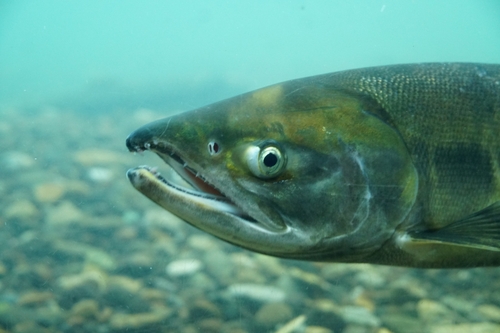
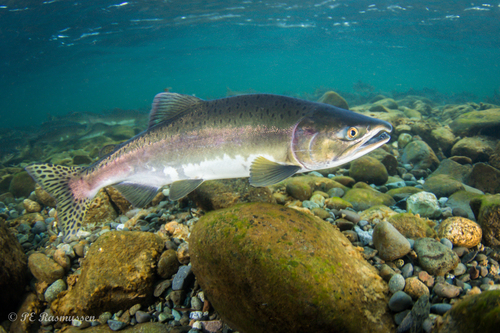
When living in the ocean, pink salmon (Oncorhynchus gorbuscha) are bright silver fish. After returning to spawning streams, their color changes to pale grey on the back with a yellowish-white belly, though some individuals turn an overall dull green color. Like all salmon, pink salmon have both a dorsal fin and an adipose fin. Key identifying traits of the species include a white mouth with black gums, no teeth on the tongue, large oval-shaped black spots on the back, a v-shaped tail, and an anal fin with 13 to 17 soft rays. During spawning migration, males develop a prominent humped back, which gives the species its common nickname "humpies". Pink salmon average 4.8 pounds (2.2 kg) in weight; the maximum recorded size is 30 inches (76 cm) in length and 15 pounds (6.8 kg) in weight. The native range of pink salmon covers Pacific and Arctic coastal waters and rivers, extending from the Sacramento River in northern California to the Mackenzie River in Canada in the east, and from the Lena River in Siberia to Korea and Honshu, Japan in the west. In North America, pink salmon spawn from the Mackenzie River in the Arctic south to tributaries of Puget Sound, Washington. Vagrants have been reported in the San Lorenzo River near Santa Cruz, California in 1915, the Sacramento River in northern California in the 1950s, and a 2013 publication recorded a new southernmost spawning record in the Salinas River. In fall 2017, a dozen pink salmon were counted in Lagunitas Creek, approximately 25 miles (40 km) north of San Francisco, California. Pink salmon have been introduced to the Great Lakes of North America. The first recorded release of around 100 pink salmon happened in 1956, when the fish escaped into Thunder Bay of Lake Superior while being transported by seaplane to a hatchery. A surplus population of approximately 21,000 hatchery-raised fingerlings from Port Arthur, Ontario was also released into the Current River, a Lake Superior tributary. Second-generation pink salmon were first caught in 1959, confirming successful natural reproduction in the lake. The Great Lakes population is self-sustaining, and has adapted to live entirely in freshwater: adults spend their adult phase in the open lake, then swim into lake tributaries to spawn. Pink salmon were first recorded in a Lake Huron tributary in 1969, reached northern Lake Michigan in 1975, and were first caught in Bayfield County, Wisconsin in 1971. By 1979, the species had spread across all of the Great Lakes. Pink salmon were also stocked along the coasts of Maine and Maryland, but these populations disappeared by 1973. While most salmon return to their birth streams to spawn, adult pink salmon wander extensively during the open water phase and some will spawn in new streams. This behavior allowed the species to spread across the entire Great Lakes within two decades. Pink salmon have also been introduced in Iran. In Europe, pink salmon have been periodically introduced to rivers of the White Sea and Barents Sea basins in Russia since 1956. Stray fish from these Russian populations have been found ascending rivers in Norway, Sweden, Ireland, Great Britain, and Iceland; self-sustaining populations have even been observed in Norway. In 2017, higher than usual numbers of pink salmon were caught in Scottish rivers, and spawning was recorded. In 2021, pink salmon were reported to have invaded the Akerselva river in downtown Oslo, Norway's capital. Pink salmon are coldwater fish, with a preferred temperature range of 5.6 to 14.6 °C, an optimal temperature of 10.1 °C, and an upper incipient lethal temperature of 25.8 °C. In their native range, pink salmon have a strict two-year life cycle, so odd-year and even-year populations do not interbreed. In the U.S. state of Washington, pink salmon spawning runs occur on odd years. Adult pink salmon leave the ocean to enter spawning streams, and usually return to the stream where they were born. Spawning takes place between late June and mid-October, in coastal streams and some longer rivers, and can occur in the intertidal zone or at stream mouths if hyporheic freshwater is available. Using her tail, a female digs a trough-shaped gravel nest called a redd (or rede, from the Scandinavian word for nest) in the stream bed to deposit her eggs. As the female releases eggs, one or more males approach and fertilize the eggs as they settle into the redd. The female then covers the newly fertilized zygotes with gravel at the top of the redd using thrusts of her tail. A female lays 1,000 to 2,000 eggs total across several clutches within her redd, often fertilized by different males. Females guard their redds until they die, which occurs within days of spawning. In dense populations, a major cause of embryo death is later-spawning fish digging new redds over existing ones. Eggs hatch between December and February, depending on water temperature. Juveniles emerge from gravel in March and April, and quickly migrate downstream to estuaries when they weigh approximately one-quarter of a gram. Pink salmon reach sexual maturity in their second year of life, and return to freshwater in summer or autumn as two-year-old adults to spawn. Commercial harvest of pink salmon is a mainstay of fisheries in both the eastern and western North Pacific. In 2010, total global harvest was around 260 million fish, equal to 400,000 tonnes. Of this 2010 total, 140 million fish were harvested by Russian fisheries and 107 million by the United States, almost all from Alaska. Pink salmon make up 69% of the total Russian salmon fishery harvest. Most pink salmon are caught using coastal set net traps, and Russian fisheries are concentrated on the east coast of Sakhalin, which averages 110,000 tonnes of pink salmon harvested per year. In North America, fish traps were used to supply fish for commercial canning and salting starting in the late 19th century. The industry grew steadily until 1920. Pink salmon populations declined drastically during the 1940s and 1950s. Fish traps were banned in Alaska in 1959. Today, most pink salmon are caught with purse seines, drift nets, or gillnets. Pink salmon populations and harvest sizes increased rapidly after the mid-1970s, and have remained at record high numbers since the 1980s. Fishery-enhancement hatcheries produce more than 20 million harvested pink salmon annually, particularly in the northern Gulf of Alaska. Pink salmon are not grown in large numbers in fish farms. Harvested pink salmon are most often canned, smoked, or salted. Pink salmon roe is also harvested for caviar, which is a particularly valuable product in Asia. There is some evidence that the pink salmon fishing industry may be affecting the average size of pink salmon and other salmon species, as well as the abundance of species that compete with pink salmon for food and species that serve as pink salmon food sources.