About Oncorhynchus clarkii (Richardson, 1836)
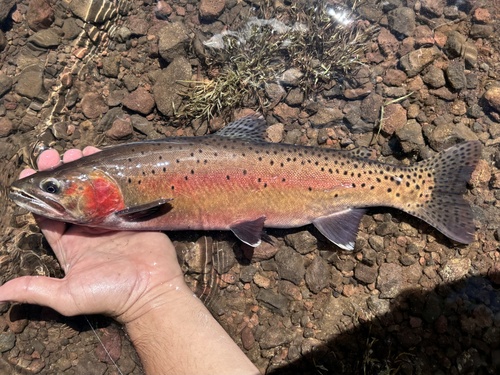
Cutthroat trout (Oncorhynchus clarkii) vary widely in size, coloration, and habitat selection across both their native and introduced ranges. Their back color can range from golden to gray to green. Cutthroat trout can generally be distinguished from rainbow trout by two key features: the presence of basibranchial teeth at the base of the tongue, and a maxillary that extends beyond the posterior edge of the eye. Depending on subspecies, strain, and habitat, most cutthroat trout have distinctive red, pink, or orange linear marks along the underside of their mandibles, in the lower folds of the gill plates. These markings give the species its common name "cutthroat", which was first given to the trout by outdoor writer Charles Hallock in an 1884 article published in The American Angler. However, these markings are not unique to the species: some populations of coastal rainbow trout (Oncorhynchus mykiss irideus) and Columbia River redband trout (O. m. gairdneri) also display reddish or pink throat markings.
When mature, different populations and subspecies of cutthroat trout range from 6 to 40 inches (15 to 102 cm) in length, with size dependent on habitat and food availability. Sea-run forms of coastal cutthroat trout average 2 to 5 pounds (0.9 to 2.3 kg). The length and weight of mature inland forms vary widely based on their specific environment and food availability. Stream-resident cutthroat trout are much smaller, weighing 0.4 to 3.2 ounces (11 to 91 g), while lacustrine (lake-dwelling) populations can reach weights of 12 to 17 lb (5.4 to 7.7 kg) in ideal conditions. The largest cutthroat trout subspecies is the Lahontan cutthroat trout (O. c. henshawi). These fish average 8 to 9 in (20 to 23 cm) in small streams, and 8 to 22 in (20 to 56 cm) in larger rivers and lakes. In ideal environments, Lahontan cutthroat trout typically reach weights of 0.25 to 8 lb (0.11 to 3.63 kg). The world record cutthroat trout is a Lahontan cutthroat trout, measuring 39 in (99 cm) and weighing 41 lb (19 kg).
Cutthroat trout are native to western North America, and have evolved through geographic isolation into at least 25 genetically recognizable lineages, each native to a different major drainage basin. Native cutthroat trout populations are found along the Pacific Northwest coast from Alaska through British Columbia into northern California, as well as in the Cascade Range, the Great Basin, and throughout the Rocky Mountains including southern Alberta. Some coastal populations of the coastal cutthroat trout (O. c. clarkii) are semi-anadromous: they spend a few months in marine environments to feed as adults, then return to fresh water from fall through early spring to feed on insects and spawn. Among North American trout, cutthroat trout have the second-largest historic native range; only lake trout (Salvelinus namaycush) have a larger historic range. The ranges of some subspecies, particularly the westslope cutthroat trout (O. c. lewisi), have been reduced to less than 10 percent of their historic range due to habitat loss and the introduction of non-native species.
Although cutthroat trout are members of Oncorhynchus, the Pacific trout and salmon genus, multiple lineages have evolved established populations east of the Continental Divide, in the upper Missouri River basin, upper Arkansas and Platte River basins, and upper Yellowstone River basin. All these basins drain into the Atlantic basin via the Mississippi River (in 2005, researchers published a report stating that a natural population of O. mykiss, the Conchos trout, is also located in an Atlantic basin drainage). Scientists believe that climatic and geologic conditions 3–5 million years ago allowed cutthroat trout from the Snake River to migrate over the Continental Divide into the Yellowstone plateau via Two Ocean Pass. There is also evidence that Yellowstone Lake once drained south into the Snake River drainage. Evidence suggests that westslope cutthroat trout established populations east of the divide via Summit Lake at Marias Pass, which at one time connected the Flathead River drainage with the upper Missouri River drainage. Scientists speculate that several mountain passes associated with the headwaters of the Colorado River drainage and Arkansas/Platte River drainages would have allowed cutthroat trout to migrate east of the divide.
Cutthroat trout have been introduced into non-native waters outside their historic native range, but not to the same extent as rainbow trout (O. mykiss). Within the native range of the Yellowstone cutthroat trout, U.S. Fisheries Bureau and National Park Service authorities introduced Yellowstone cutthroat trout into many fishless lakes in Yellowstone National Park. Cutthroat trout were introduced into Lake Michigan tributaries in the 1890s and sporadically in the early 20th century, but never established wild populations there. A population of Yellowstone cutthroat trout is purported to have become established in Lake Huron. The Arizona Game and Fish Department routinely introduces cutthroat trout into high mountain lakes in the White Mountains of northeastern Arizona.
Cutthroat trout require cold, clear, well-oxygenated, shallow rivers with gravel bottoms, or cold, moderately deep lakes. Healthy streamside vegetation that reduces siltation is typical of high-quality cutthroat trout habitat, and beaver ponds may provide refuge during periods of drought and over winter. Most populations stay in fresh water throughout their lives, and are classified as nonmigratory, stream-resident, or riverine populations. The coastal cutthroat trout (O. c. clarkii) is the only cutthroat trout subspecies that has coevolved across its entire range with coastal rainbow trout (O. m. irideus). Portions of the westslope cutthroat trout's (O. c. lewisi) range overlap with Columbia River redband trout (O. m. gairdneri), but the majority of its native range lies in headwater tributary streams above major waterfalls and other barriers that block upstream migration. At least three subspecies are confined to isolated basins in the Great Basin and can tolerate saline or alkaline water.
Cutthroat trout are opportunistic feeders. Stream-resident cutthroat trout primarily feed on larval, pupal, and adult forms of aquatic insects (typically caddisflies, stoneflies, mayflies, and aquatic dipterans), adult forms of terrestrial insects (typically ants, beetles, grasshoppers, and crickets) that fall into the water, fish eggs, small fish, crayfish, shrimp, and other crustaceans. As they grow, the proportion of fish in their diet increases in most populations. In saltwater estuaries and along beaches, coastal cutthroat trout feed on small fish such as sculpins, sand lance, salmon fry, and herring. They also consume shrimp, small squid, and krill. In fresh water, they have the same diet as stream-resident trout: aquatic insects and crustaceans, amphibians, earthworms, small fish, and fish eggs. Within the range of the bull trout (Salvelinus confluentus), cutthroat trout act as a forage fish for the piscivorous bull trout.