About Oncorhynchus aguabonita (Jordan, 1892)
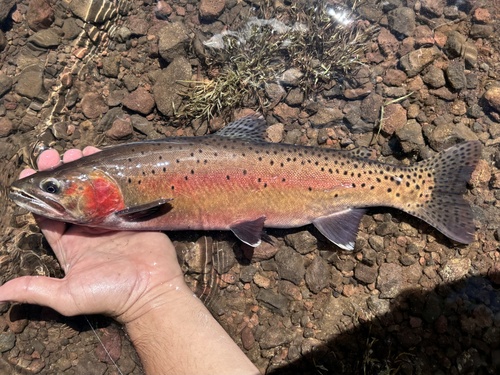
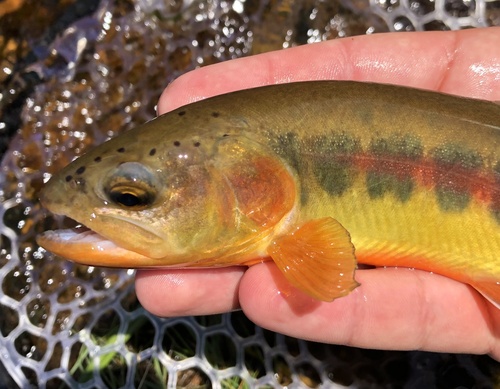
The golden trout, scientifically named Oncorhynchus aguabonita (Jordan, 1892), has golden flanks marked with red horizontal bands along the lateral lines on each side, and around 10 dark, vertical oval markings called "parr marks" on each flank. The dorsal, lateral, and anal fins have white leading edges. In its native habitat, adult golden trout range from 6 to 12 inches (15 to 30 cm) in length, and any fish over 12 inches (30 cm) is considered large. Golden trout that have been transplanted to lakes have been recorded reaching up to 11 pounds (5.0 kg). The golden trout should be distinguished from the similarly named golden rainbow trout, which is also called palomino trout. The golden rainbow trout is just a color variant of the rainbow trout. The golden trout is commonly found at elevations between 6,890 feet (2,100 m) and 10,000 feet (3,000 m) above sea level, and is native to California's southern Sierra Nevada mountains. Outside of its native range in California, golden trout are more often found in cirques and creeks in wilderness areas at 10,500–12,000 feet (3,200–3,700 m) elevation. These locations are often in high passes that cannot be crossed without crampons, ice axes, and ropes until after the Fourth of July. The golden trout's preferred water temperature is 58 to 62 °F (14 to 17 °C), but it can tolerate temperatures as high as 70 °F (21 °C) in degraded streams on the Kern Plateau, as long as these waters cool overnight. The Sacramento sucker (Catostomus occidentalis occidentalis) is the only other fish species indigenous to the golden trout's native California range. O. aguabonita is native to the southern Sierra Nevada, including the upper reach and tributaries of the South Fork of the Kern River, plus Golden Trout Creek and its tributaries. It has been introduced into hundreds of lakes and streams outside its native range, though most of these introduced populations did not persist, or hybridized with cutthroat trout and other subspecies of rainbow trout. For sportfishing, the golden trout was translocated many times during the twentieth century into multiple Western U.S. states. Established populations still survive in California, Idaho, Montana, Utah, Washington, Colorado, and Wyoming. Populations in high-elevation lakes of Nevada's Ruby Mountains have died out. There is no current documentation available for the status of golden trout in Arizona, New Mexico and Oregon, the other states where California golden trout were planted. That said, a former New Mexico population is relatively well known and storied: when then-Colonel Chuck Yeager introduced his commanding officer, General Irving "Twig" Branch, to golden trout populations in the Sierra Nevada, Branch ordered Yeager and Bud Anderson to introduce the species to New Mexico's mountain streams. These New Mexico populations have also since died out. In his second memoir, Press On, Yeager described his annual fishing trips to catch golden trout, and he praises the species as one of the best game fish and best eating fish available. A self-sustaining introduced population of golden trout also exists in the Rocky Mountains of Alberta, Canada. The province manages its golden trout population by translocating fish between lakes to balance populations, and does not introduce new fish from other populations. Golden trout have also been introduced to Kilnsley Park, Yorkshire Dales in England.