About Oncopeltus fasciatus (Dallas, 1852)
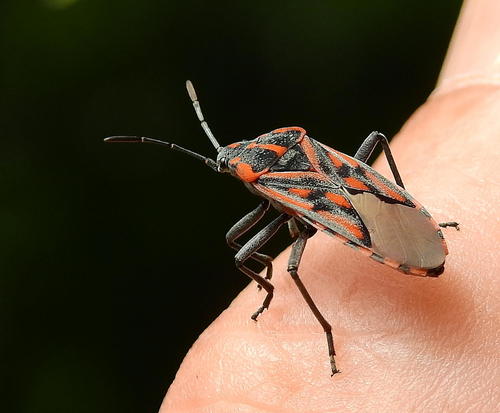
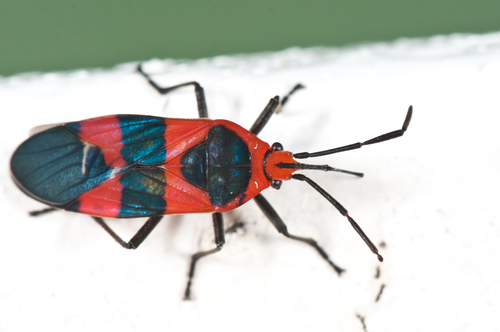
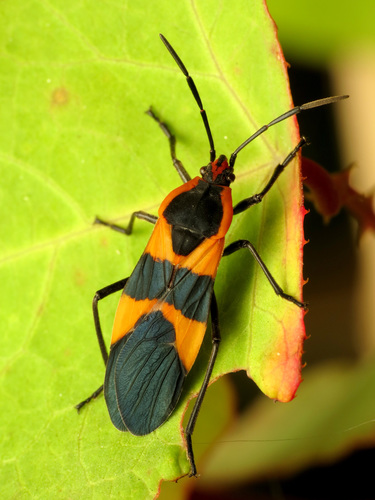
Oncopeltus fasciatus (Dallas, 1852), commonly called the large milkweed bug, has the following characteristics. For identification, adult individuals range from 11 to 12 mm long. They have a red/orange and black X-shaped pattern on their wings, positioned under the triangle that is characteristic of hemipterans. This bold pattern is highly visible, and works as an aposematic warning to predators. O. fasciatus is noxious to predators and exhibits Müllerian mimicry. On the ventral side of the fourth abdominal segment, males have a black band, while females have two black spots. Newly hatched juveniles are mostly red with black antennae and a small number of black spots. As they grow, they develop additional black spots and wing pads. The eggs of this species are bright orange and easy to detect. The large milkweed bug is a hemimetabolous insect, meaning it grows through stages called instars and undergoes incomplete metamorphosis, showing small gradual changes throughout development such as shifts in coloration, and development of wings and genitalia. O. fasciatus begins life as an egg, goes through four nymphal stages over 28–30 days, then molts to reach adulthood. Females become sexually receptive within a few days after reaching adulthood. Geographic location has a large effect on egg production rate and clutch size, though the intrinsic increase in reproduction depends on the climate that the individual has acclimated to. As an example, two close populations 60 km apart living on a sharp incline have different optimal temperatures for reproduction: the higher-elevation, cooler-adapted population has an optimal temperature of 23 °C, and the lower-elevation, warmer-adapted population has an optimal temperature of 27 °C. The highest clutch size occurs in populations from Puerto Rico, Florida, and Texas, at 30–50 eggs per clutch. The lowest clutch size was found in California populations, at 25–30 eggs per clutch. Northern populations in Iowa and Maryland have an intermediate clutch size between these two extremes, from 25 to 35 eggs per clutch. In favorable conditions, such as the tropics, reproduction occurs continuously year round. In less-favorable conditions like temperate zones, reproduction occurs only during warmer months. When migrant individuals arrive and reproduce, this introduces gene flow between northern and southern populations, which gives an advantage to midrange populations that experience variable climates, because it allows females to ensure genetic variability. Depending on climate and geographic location, the milkweed bug can produce one to three generations per year. O. fasciatus faces strong selection for survival, and will halt reproduction if conditions are not ideal. Diapause occurs on short cold days in temperate regions, and occasionally during the dry season in tropical regions. Most populations of the milkweed bug overwinter, usually after migrating to their overwintering sites in response to environmental triggers such as temperature and photoperiod. However, photoperiod only predicts overwintering in areas where day length affects the maturation of milkweed. For this reason, no overwintering occurs in tropical regions, as it does not provide an adaptive advantage there. The large milkweed bug is often used as a model organism and reared for laboratory experiments. It is suited to this use because it is easy to rear and handle, has a short developmental time, few instars, and high fecundity. The phylogenetic placement of O. fasciatus makes it ideal as an outgroup to compare with more derived holometabolous insects, making it a valuable organism for the study of evolutionary patterns.