About Onchidoris bilamellata (Linnaeus, 1767)
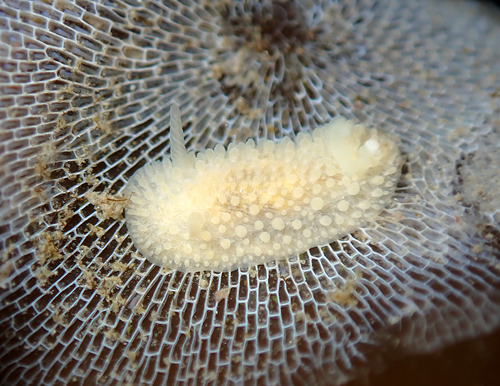
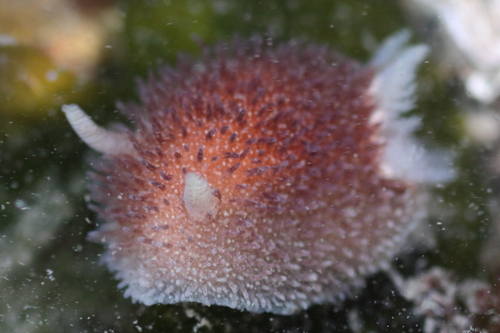
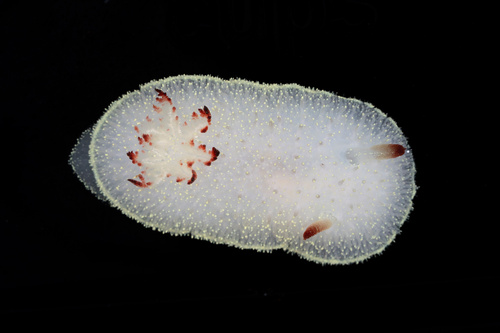
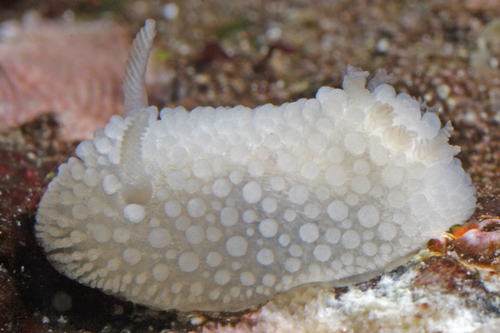
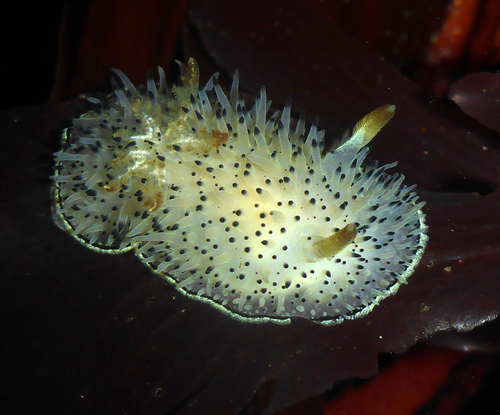
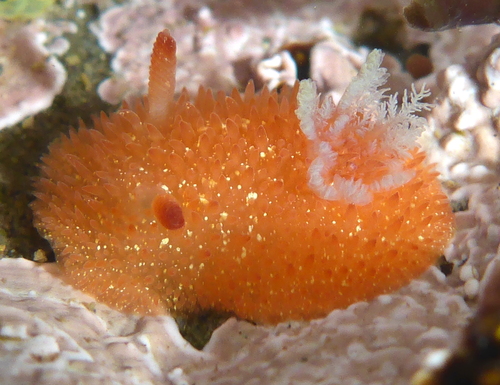
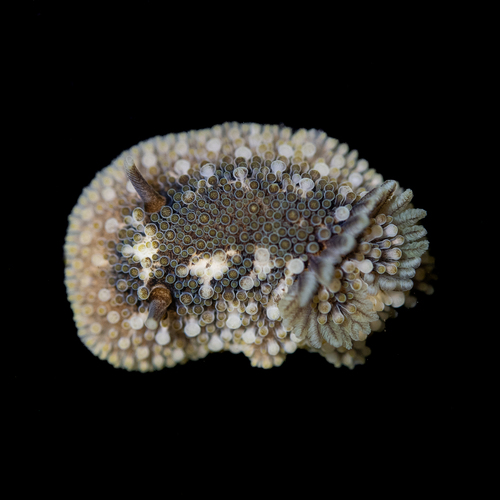
The maximum recorded body length of Onchidoris bilamellata is 38 mm. Most individuals have abundant rusty brown pigment. Some individuals show a mixed color pattern, ranging from lighter brown to dark brown. Fewer individuals are white, with brown coloration only on their rhinophores and gills. A small number of rare individuals are completely white, and they are not albinos because their eyes have pigment. Onchidoris bilamellata has a broadly oval body shape, and its back is covered with short, knobby papillae. Its antennae are comblike. The gills are arranged in two half rings on the rear of the back, and consist of 16 to 32 simple featherlike plumes. The branchial ganglia are fused in this species. This nudibranch has a wide distribution, occurring mainly in colder intertidal waters down to a depth of approximately 20 m. It has been found in the North Atlantic and North Sea, ranging from Britain and France to the Norwegian Sea, Iceland, and Greenland; it also occurs along the North American coast as far south as Connecticut. It has also been recorded in the North Pacific, in the Bering Sea, and from Alaska south to northern California. These sea slugs sometimes occur in very large numbers during breeding season. On numerous observations, they form swarms with over 1,000 individuals per square metre. All individuals in these swarms face the same direction, which is determined by tidal flow. They follow each other at the same speed, forming columns in tightly packed rows. The minimum recorded depth for this species is 0 m, and the maximum recorded depth is 55 m.